Skip the Stressful Autostrade and See Italy by Train Instead
Forget car hire in Italy – taking the train is way more relaxing
Most people planning their first (or fifth) Italian trip eventually end up asking themselves the same question: is car hire in Italy worth it? Italy's roads are romantic in theory, winding through olive groves, cresting a hill to a hilltop town hanging in the sky, with the opportunity to stop on a whim for a roadside espresso.
But the ideals go up in smoke when you stop daydreaming and start being realistic. Driving across Italy can come with extra planning, logistical headaches and stress, which, last time we checked, clashes badly with that romantic daydream.
The Autostrade toll system, which requires stops at toll booths, is often cash only and can be confusing if you’re having to contend with undertaking, tailgating and all the other joys of driving in Italy. The highways themselves, while fairly efficient, aren’t that scenic either, designed to move goods and people from A to B as quickly as possible, rather than join up UNESCO World Heritage sites or offer a pretty view.
Off the motorways, the story is the same: clogged city streets, a ‘dynamic’ brand of driving and the very real possibility of low speed collisions or lost wing mirrors that many Italians treat as part and parcel of driving.
Amd that’s all before you try and park your car. Italy's historic centres are almost universally governed by Zona a Traffico Limitato (ZTL), legally enforced restricted traffic zones monitored by cameras that silently issue fines to any non-resident vehicle that enters. In Florence alone, the city collected €61.6 million in traffic violation fines in 2024. Certain breaches can result in fines totalling up to €335, and rental car companies naturally add their own administrative surcharges on top.
You can drive for hours from the countryside, arrive at the gates of the city you came to see, and still be unable to get anywhere near it without a fine landing in the post weeks later, if you haven’t done some administration and potentially learned how to read Italian so you can spot the roadsigns warning you of restrictions.
As you can see, the case for the train is not just aesthetic. It's practical, it's cheaper, and if you choose the right routes, it's the single best thing you can do for the trip.
If you’re already thinking about how you’ll miss out on the amazing experiences where the train doesn’t go, it’s worth remembering Italy's rail network stretches well beyond the high-speed Frecciarossa corridors connecting Rome, Florence, and Milan that every tourist already knows about.
What lies beyond those corridors, in Sardinia's interior, in the volcanic approaches to Sicily, in the German-inflected valleys of South Tyrol, and in the Ligurian mountains above Genoa, is proof that you can escape the radius of a main train station and see the real Italy, even without a car to take you the last mile.
So here are some of Italy’s finest train routes that allow you to skip the potentially misery-causing Italian roads and enjoy Bella Italia at a different pace.
Italy’s High Speed Backbone

Italy's high-speed rail network has essentially made flying between major cities redundant. Trains are quick, comfortable, you’ll get all the mod cons like Wi-Fi and charging ports, plus there is of course on-board dining and first class options.
Milan to Rome takes as little as 2 hours and 55 minutes, Rome to Florence 1 hour and 23 minutes and Rome to Venice 3 hours and 45 minutes. These all operate city centre to city centre, with no airport transfer, no security queue, and no ZTL waiting at the other end.
Two operators compete on these lines. Trenitalia's Frecciarossa runs up to 88 direct Milan–Rome services daily, offers four classes including at-seat meal service in the upper tiers, and has a proper café-bar car on every train.
Private competitor Italo, Europe's first private open-access high-speed operator when it launched in 2012, runs on the same tracks, serves the same stations, and features Poltrona Frau leather seats in all classes, because this is Italy after all.
Both are excellent and the competition keeps fares low. Advance Super Economy and Low Cost tickets on the Milan–Rome route can start below €20, so booking early makes a significant difference. Omio compares both operators in a single search.
The Train That Boards a Ferry

There is no more structurally dramatic train journey in Europe than the InterCity Notte from Rome to Palermo or Syracuse, and the reason has nothing to do with the carriages or the cuisine.
The Intercity Notte, originally a night train (hence the name) links the capital Rome to cities of Syracuse and Palermo on the island of Siciliy. It is easily one of the most unique train journeys both in Italy and in Europe.
To get across the strait of Messina, the train doesn’t stop, force its passengers onto a ship, where they hop on another train on the other side. The train simply pulls onto a special ferry that has tracks built into its cargo deck.
The InterCity Notte is the only train in Europe that actually boards a ferry as part of its standard passenger service, and it’s the quite the experience.
After tracking following the Tyrrhenian coast from Rome via Naples (with Vesuvius visible from the window across the Bay of Naples) the train reaches Villa San Giovanni at the toe of Italy. It is then carefully shunted in sections onto a purpose-built train ferry, with passengers barely noticing. The crossing of the Strait of Messina takes around 20 to 30 minutes, during which you can either stay in your compartment or climb up to the ferry's upper deck for sea air and a view of Sicily materialising across the water.
Hate packing?
Try our packing list generator. Select the country you’re visiting, month of travel, any specific activities and our tool generates a handy personalised packing list with all the essentials. You can even download or print your list.
You can still take the night version of this service, and it’s is pretty efficient too. You go to sleep in Rome and wake up in Palermo, having saved both a hotel night, a bleary-eyed ferry transfer and a carbon-expensive flight.
Trenitalia's InterCity Notte carriages include both couchette compartments and proper sleeper cabins, with the more upmarket 'Superior' class including private toilets and showers. Fares are still an absolute bargain too, with tickets available from €22.90 when we searched in April 2026, making this extraordinary journey one of the cheapest long distance rail routes in the whole of Europe.
You don’t need a car when you arrive on Sicily either. Trenitalia and TUA Agrigento now operate an add-on to your ticket that delivers passengers directly to the Valley of the Temples.
The Valley of the Temples is the largest archaeological park in the world, and the Temple of Concordia is one of the best-preserved Doric temples anywhere outside Greece, dating to the fifth century BC.
The train from Palermo Centrale to Agrigento takes just over two hours and winds through citrus groves and sleepy villages on its way across the island. Agrigento was also named Italy's Capital of Culture for 2025, which means the city's cultural calendar has been particularly rich.
The Longest Tourist Railway in Europe

Continuing to stay away from the mainland for now, Italy’s other ‘big’ island Sardinia has one of the most remarkable rail experiences in the world. The Trenino Verde (the 'Little Green Train') is the longest tourist railway network in Europe, running across 438 kilometres of narrow-gauge track through the island's mountainous interior.
The name, coined officially in 1984, refers not to the colour of the engines or carriages, but to the extraordinary density of vegetation encountered along every route. Cork forests, maquis scrubland and chestnut groves are interspersed with limestone formations, ancient nuraghi, and villages that appear to exist in a different century.
The line's roots go back to the late nineteenth century. D.H. Lawrence, travelling the island in 1921 and later writing about it in Sea and Sardinia, described riding the routes and their slow, winding progress through unspoiled landscapes. The good news is that the same experience today, as Lawrence found it then, really hasn't changed very much.
Unlike many heritage railways, which sometimes offer a single line and maybe a branch or two, the Trenino Verde has five distinct routes to choose from. The most dramatic is the Mandas–Arbatax line, which climbs to 800 metres above sea level through the Barbaria region and the Gennargentu massif, crossing bridges over Lake Flumendosa and passing through tunnels bored through solid rock. The route passes through natural reserves, archaeological sites, and abandoned villages. You wouldn’t be able to reach some of these by car anyway.
The Macomer–Bosa route drops from 500 metres through the Valle del Malvasia to the sea at Bosa, a colourful coastal town built around a medieval castle. The Sassari–Palau line runs through the Gallura region, past cork forests and Lake Liscia, arriving at the resort of Palau opposite the Maddalena archipelago. Tickets start from around €15, and the vintage 1930s carriages remain essentially unchanged.
Those staying in Cagliari can connect via metro to Monserrato, then onward to Mandas as the starting point for multiple routes.
The Train through the Alps

Northeastern Italy has a distinctive flavour that sets it apart from the rest of the country, and this train is a great way to experience it.
The province of South Tyrol, ceded from the Austro-Hungarian Empire to Italy after World War One, is German-speaking, architecturally alpine, and oriented around vineyards and mountain meadows that feel a million miles from Rome or Florence.
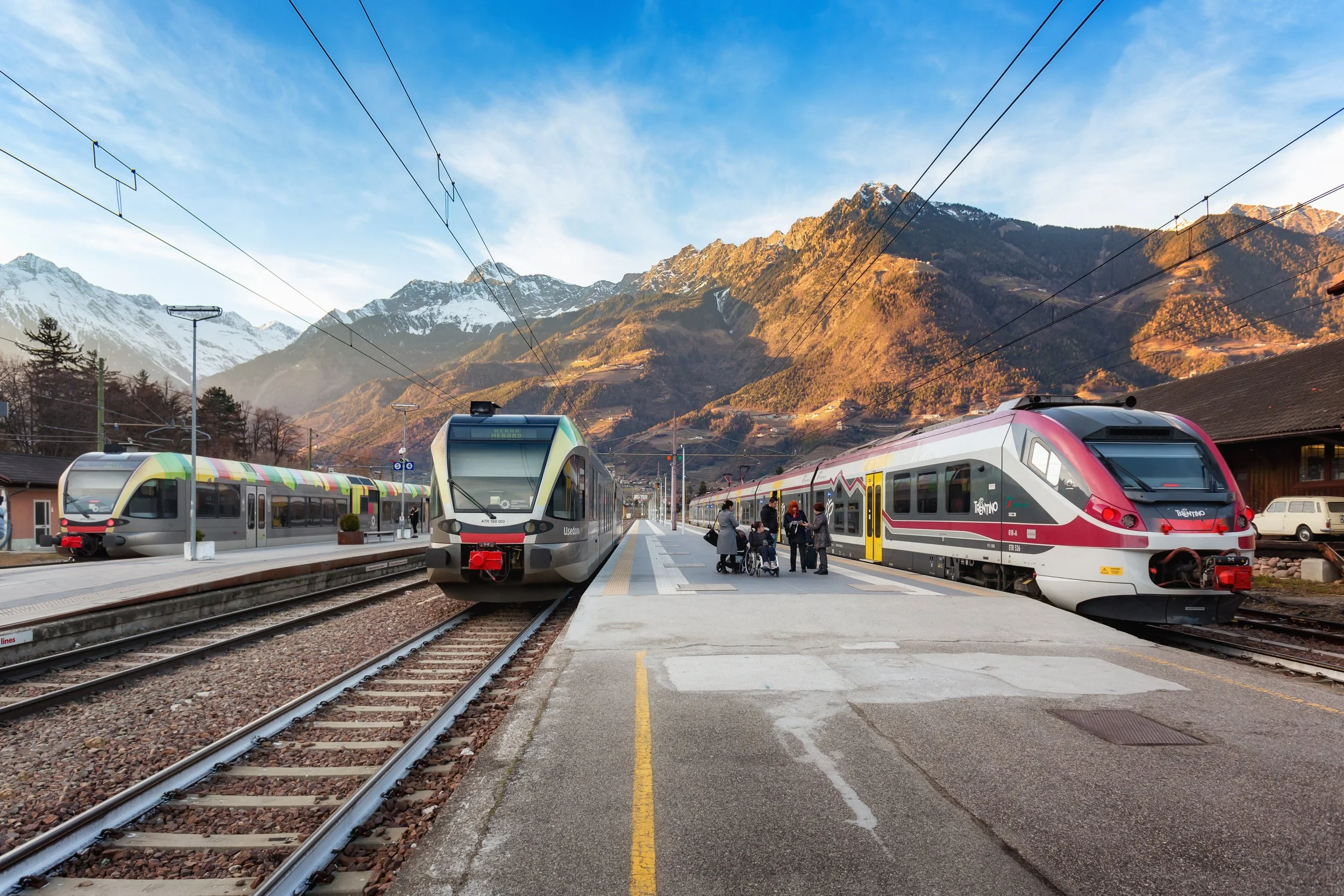
The Val Venosta (Vinschgau) Railway, connecting the thermal city of Merano to the valley town of Malles near the Swiss border, offers 60km of some of the most quietly beautiful scenery in Europe that just doesn’t feel the same out of a car window.
The line was originally inaugurated in 1906 during the Austro-Hungarian era, before falling intro disrepair later in the century. At the turn of the millennium, the line was closed and remained for 15 years. The province of South Tyrol spotted the oppurtunity for a scenic railway as it looked towards a tourism-heavy future and invested in a complete renovation and reopened it in 2005.
The 18 stations along the route were each carefully restored in collaboration with the provincial heritage office, preserving their original early-twentieth-century architecture while integrating modern platform infrastructure.
The train's large panoramic windows frame a progression of orderly vineyards, apple orchards, Romanesque churches, and castles rising from the valley floor, with the peaks of the Alps, including the Ortler massif, looming over the bends and bridges.
An extra cherry on the cake is that every station has a bike rental point connecting to the Val Venosta cycle path, one of Italy's best long-distance cycling routes.
The train can essentially function as a lift too: ride to a any station, rent a bike and coast back through the valley at your own pace, stopping in villages that most visitors who stick to the tracks miss out on. Merano itself, a spa city full of Art Nouveau architecture and with its own mild microclimate, has long been favoured by the European aristocracy. Hotel Castel above the city offers dramatic views across the valley from its terraced gardens.
Note: as of spring 2026, sections of the Vinschgau Railway have been undergoing renovation work, with gradual resumption of services beginning from Merano toward Lasa from March 29, 2026. Check suedtirol.info for updated timetables before travelling.
Genoa's Hidden Mountain Line

Genoa generally misses out on the tourist crowds, or acts as a stop off, which is both a shame and blessing. The Genoa-Casella railway is just one underused element of Italy’s famous old port city that is rarely swamped with tourists.
The old rail system that Genoa residents still use to commute from the Ligurian Apennines every morning doubles up as a heritage railway, using the original line and old rolling stock that’s still doing the job.
The Genoa–Casella Railway is a 24.3-kilometre narrow-gauge line opened in 1929, departing from the Manin station in the Castelletto district and climbing through three valleys, Val Bisagno, Val Polcevera, and Valle Scrivia, to the mountain village of Casella at 410 metres above sea level. The result is a winding route that has not shortage of incredible scenery.
The line's nine daily services take around an hour each way, but the contrast between the city and Casella befits a much longer journey. Here, the pace is slower and the hills open out into the Ligurian hinterland, a region that most people driving the coastal motorway simply never get to see.
It’s a good idea to hop off at at least one of the stops along the route too.
At the Trensasco stop, trails connect to the fortifications of Genoa's historic ring of hillforts. At Sant'Olcese Chiesa, the village is famous throughout Liguria for its salami, a mixed pork and beef cured meat smoked over wood, distinct from almost anything you'd find elsewhere in Italy. Taste it at Salumeria Parodi, which also runs guided tours through its production process.
Another great stop off is the Crocetta d'Orero station, where a museum traces the railway's own history through photographs, historic tickets, and old instruments. The museum is open every Saturday morning.
In Casella itself, hiking trails lead up to the hamlet of Montemaggio and the summit of Monte Maggio with more magnificent views of the Ligurian mountain valleys.
The Train Through the Tuscan Wilderness

Most visitors to Tuscany barely make it to Lucca, a pretty town famous for its defensive walls. Even fewer walk to the station and board the train north through the still relatively unknown Garfagnana Valley. The Ferrovia della Garfagnana remains one of the least-touristed train routes in Italy despite running through some of its most dramatic scenery.
The Lucca–Aulla line takes just under two hours, tracking the Serchio river from the flat Lucchese plain up into the Apuan Alps through limestone gorges and chestnut forest. The line crosses remarkable masonry viaducts that are still going strong after a century.
The first stop worth leaving the train for is Borgo a Mozzano, where the medieval Ponte della Maddalena, known locally as the Devil's Bridge, crosses the Serchio in an asymmetric profile of one large arch flanked by three smaller ones.
Shortly after comes Barga, known as "the most Scottish town in Italy": in the late 19th century, economic crisis drove mass emigration from Barga to Glasgow and Edinburgh, and between 40 and 60 percent of the town's current residents have Scottish relatives.
The medieval hilltop centre has a Romanesque duomo, a Celtic supporters' club, an annual fish and chip festival in July and August, and bars where a conversation might shift mid-sentence from Italian to Glaswegian. Paulo Nutini's great-grandfather ran the family chip shop in Paisley.
Beyond Barga the line climbs through Castelnuovo di Garfagnana — where the Rocca Ariostesca fortress housed the poet Ariosto as provincial governor for three years in the sixteenth century — and terminates at Aulla, with onward connections to La Spezia and the Cinque Terre coast.
Discover Garfagnana
Trulli, Ravines, and the Deep South

The southeast of Italy, and Puglia specifically, is one of the country's fastest-growing tourist destinations, and for good reason. But the majority of visitors still hire a car and drive between the whitewashed towns of the Valle d'Itria – once they’ve sat in a fair amount of traffic, that is.
What they miss is that the Ferrovie del Sud Est (FSE) network connects Bari directly to Alberobello, Locorotondo, Martina Franca, and onward to underrated Lecce, threading through the landscape of trulli-dotted hillsides and ancient olive groves that is making the region ever more popular.
The trulli themselves deserve some explanation, because the architecture is stranger and more interesting than the tourism brochures suggest. The trulli of the Itria Valley are limestone dwellings built using an ancient dry-stone technique — no mortar, no cement — with conical corbelled roofs stacked from hand-cut limestone slabs.
The UNESCO World Heritage listing awarded in 1996 covers the two historic quarters of Alberobello, the Rione Monti and the Aia Piccola, where over 1,500 trulli survive essentially unchanged. The origin of the form is genuinely contested, but the most compelling theory holds that the dry-stone construction method was deliberately chosen because entire settlements could be dismantled rapidly when tax inspectors from the Kingdom of Naples approached.
Beyond Alberobello you can stop at Locorotondo, a perfectly circular whitewashed hilltop town which produces its own DOC sparkling white wine. Martina Franca is another decent stopping point. Its baroque seventeenth-century palaces are usually skipped over on car journeys.
From Bari, you can hop on board the Ferrovie Appulo Lucane, which continues inland to Matera, the cave city that is sneaking its way into many Italy articles and brochures. The town’s own cave hotel, Sextantio Le Grotte della Civita, with bedrooms set inside original rock chambers, is among the most unusual places to sleep in Europe.
More Italy