Visit the Hidden Room Under a Florence Church Where Michelangelo Hid – and Sketched
A secret room below the Medici Chapels is still covered in original sketches from the Renaissance master
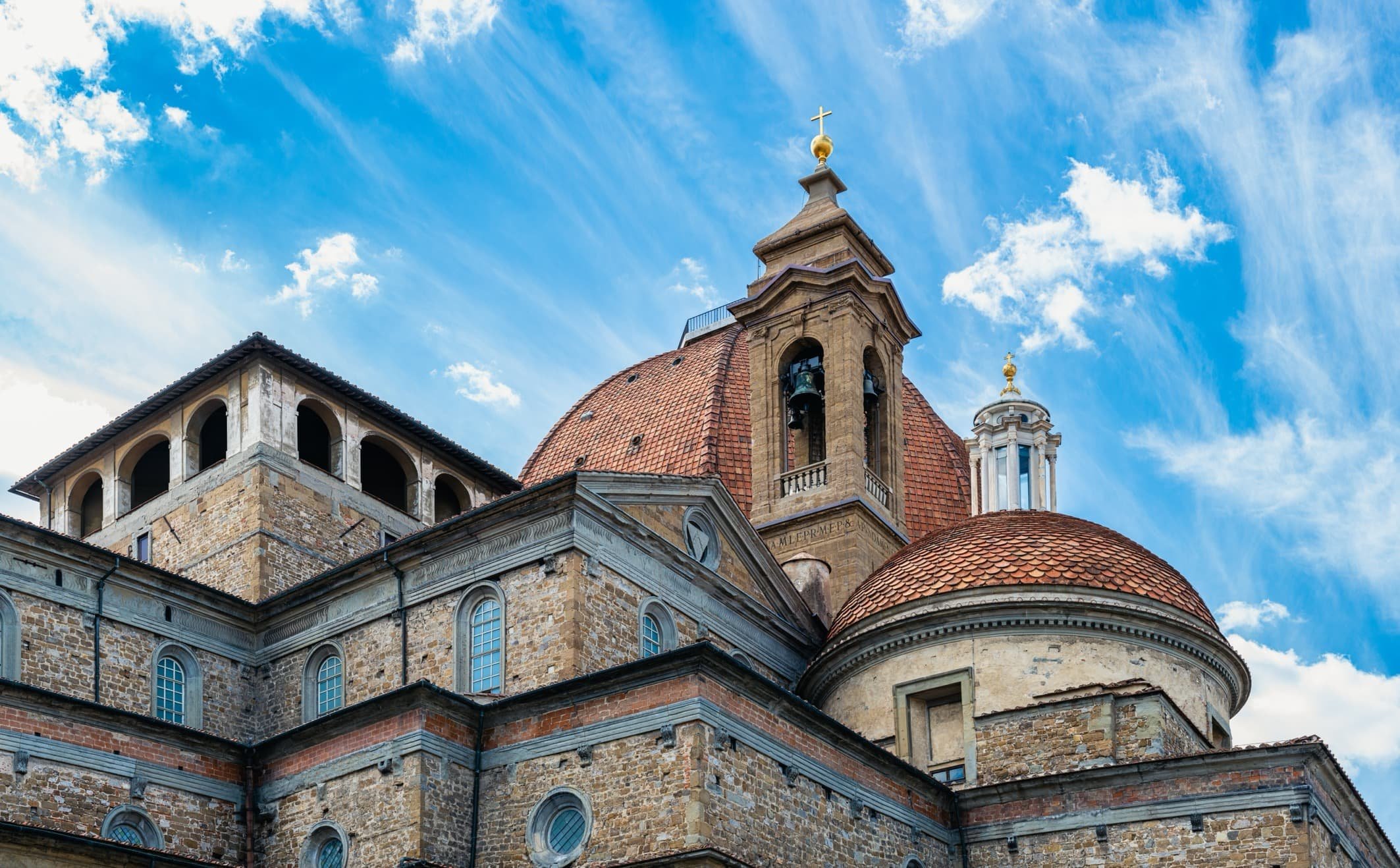
Directly beneath the New Sacristy of the Basilica of San Lorenzo, the mausoleum Michelangelo designed for the Medici family, there is a room that has held several secrets in its existence. It measures 10 metres long by three metres wide, has one small window and is covered in drawings from one of the world’s defining artists that were never really meant to be seen.
In the summer of 1530, Michelangelo Buonarroti was a wanted man. He had spent three years working for the short-lived Republic of Florence, designing military fortifications to keep the Medici out of their own city.
When the Republic fell and the Medici returned to power, Pope Clement VII, himself a Medici, was out for vengeance. Supporters of the Republic were killed or exiled. Michelangelo, who had grown up in the Medici household and had known the Pope since boyhood, faced the real possibility of execution.
A Trapdoor, a Wardrobe, and a Coal Cellar
In the wake of judicial revenage, the prior of San Lorenzo, a Giovan Battista Figiovanni, smuggled Michelangelo into a cramped basement beneath the very chapel he had been building for the family that now wanted him dead.
The space was a former coal deposit, accessible only through a trapdoor reached by a narrow stone staircase. Once Michelangelo was inside, the trapdoor was concealed beneath various wardrobes and stacked furniture. And for roughly two months, between late June and October 1530, one of the greatest artists in human history sat quietly in a cellar with barely any natural light and waited to learn whether he would be pardoned or killed.
Like most restless geniuses, and probably to stave off the boredom, Michelangelo focused on his work, especially continuing what sat above his makeshift prison. Armed with charcoal sticks and sanguine chalk, Michelangelo turned the walls into something Paola D'Agostino, then director of the Bargello Museums, later described as a three-dimensional sketchbook.
The drawings are extraordinary: large-scale anatomical studies, preparatory figures for the sculptures that would literally be installed over his head in the New Sacristy, references to classical works including the head of the Laocoön, and what some believe to be a self-portrait.
Many overlap. Some are monumental in scale, others are rapid, summary marks, the kind of doodling you might do if you were hiding in a cellar, sweating about a potential execution.
500 Years Under Plaster
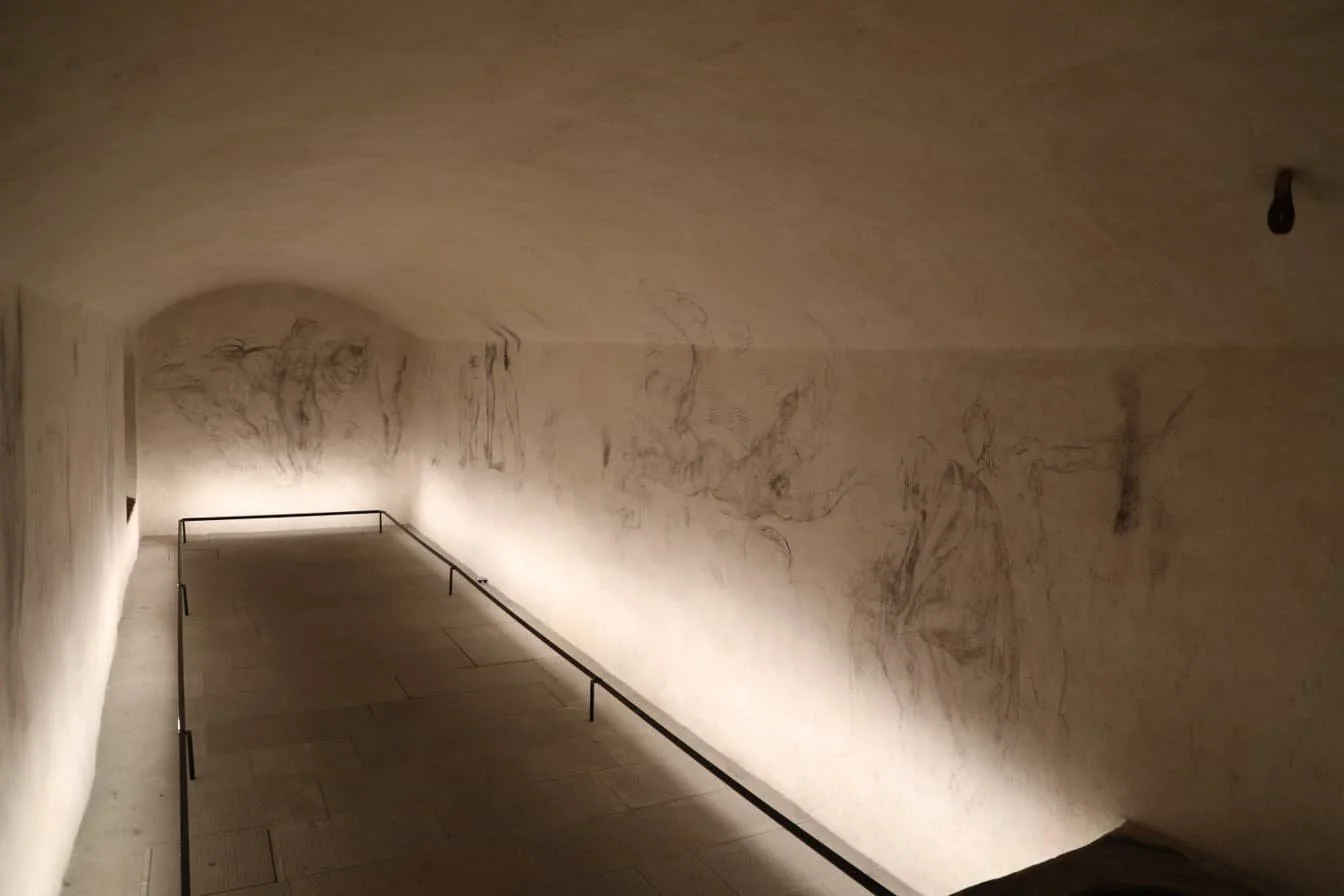
Photo credit: Francesco Bini| | CC BY-SA 4.0
The story, as you may already may know, has a strange ending. Clement VII possibly experienced a moment forgiveness and let it be known that Michelangelo could return to work, unpunished, provided he finished the family tombs. Turns out pardoning best artist, who was halfway through the job, was worth more than executing an alleged traitor!
The artist emerged, resumed his duties, and never mentioned where he had been hiding. Within a few years, the room was plastered over and went back to being used for storage for the next few hundreds year.
It was only in November 1975, when museum director Paolo Dal Poggetto sent a restorer named Sabino Giovannoni down to conduct cleaning tests for a new visitor exit in a corridor beneath the apse of the New Sacristy, that the whole room went from forgotten chamber to astonishing discovery.
Giovannoni removed two layers of plaster and found, drawn across the walls with the confidence and fluency of a master draughtsman, dozens of figures in charcoal and red chalk.
Attributing the works to Michelangelo wasn’t a straightforward agreement, with some believing they may have been done by someone else emulating his work, or may have been done by a different artist(s) altogether.
But the consensus today is that the majority are his. The style, the scale, the subject matter, and the historical timeline all align. What the restorer had uncovered was, in effect, the private visual diary of a Renaissance master under mortal threat, and perhaps some additions from others before the plaster went on.
The Most Limited Ticket in Florence
For nearly 50 years after its discovery, the Stanza Segreta was accessible only to scholars and conservators. The charcoal is extraordinarily fragile, and even controlled light exposure poses a risk.
But after careful consideration and some environmental measures, the room finally opened to the public on 15 November 2023.
There were and are still some strict rules to ensure these masterpieces remain safe and secure: four visitors at a time, fifteen minutes per slot, no backpacks or anything else that could damage the wall surfaces.
Between each visit, the room is sealed and returned to total darkness, a conservation measure designed to protect the charcoal from the cumulative effects of even the most advanced LED lights designed to minimise damage.
No more than 100 visitors are admitted per week and flash photography is prohibited – apparently staff have started asking visitors to avoid even phone photographs, to minimise light exposure just from the screen as much as possible. The tricky staircase also means that children under 10 and visitors with mobility difficulties aren’t able to enter.
By 2024, the experimental opening became a regular programme, and the room is now accessible five days a week. But the access restrictions haven't eased, and demand has only grown.
Tickets sell out three to five months in advance, sometimes longer during high season. The only official booking channel is the Ministry of Culture's B-Ticket platform, and a maximum of two tickets can be purchased per transaction. So if you fancy visiting this incredible little unassuming room, you’ll need to be very well-prepared.
A New Michelangelo Trail

In good news for Florence visitors, the Bargello Museums and the Galleria dell'Accademia have formally merged into a single institutional network, bringing seven Florentine museums under one umbrella.
A itinerary titled "In the Sign of Genius" will connect works by Michelangelo across the Bargello, the Accademia, and the Medici Chapels, tracing his innovations in sculpture and architecture across the city. A 72-hour cumulative pass covers the full circuit.
The Secret Room is not included in the pass and requires its own reservation, but it provides an almost unimaginable bookend to a day spent with Michelangelo's finished masterpieces – if you plan far in advance and get lucky.
But fear not if you miss out. Upstairs in the New Sacristy, his sculpted figures of Night, Day, Dusk, and Dawn sit in composed perfection above the Medici tombs, the finished works that possibly began life in the coal cellar below.
And if you do get down there, it’s a rare opportunity to get about as close to Michelangelo as you can. There is no glass case, no crowd control rope, no air-conditioned gallery. The space is barely high enough to stand in. The drawings are at arm's length, traced on bare walls by a hand that is synonymous with art, the world over.
The Stanza Segreta di Michelangelo is accessed via the Museum of the Medici Chapels, part of the Basilica of San Lorenzo complex in central Florence. Tickets must be booked well in advance through the official B-Ticket platform. Slots are released periodically, so check three to five months ahead for availability, and earlier for summer dates. The room is open Monday and Wednesday to Saturday, with varying time slots. The Medici Chapels themselves are open Tuesday to Sunday. There is no wheelchair access to the Secret Room, no photography and no children under 10.
Read Next