The Cemetery Next to the Leaning Tower of Pisa That's Probably More Interesting
That blind-arched building spoiling your photo of the Leaning Tower? Yeh, it’s way more interesting than the world-famous campanile…
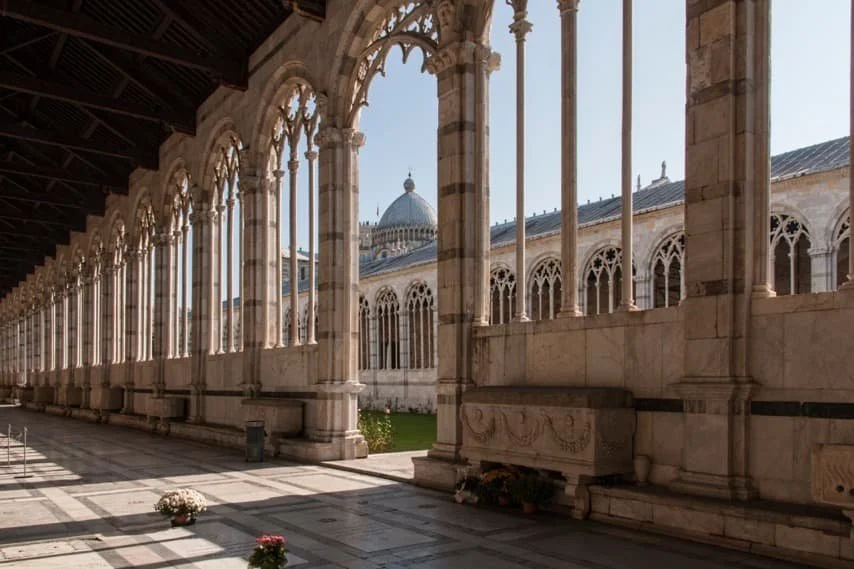
Every year, millions of visitors crowd into the Piazza dei Miracoli, queue for a timed slot up the Leaning Tower, hold up their phones for the obligatory forced-perspective photo, and leave. Most don't notice the long marble wall running along the northern edge of the square. Those who do notice it rarely go in. Their loss.
There's a building in Pisa that holds Crusade-era soil, the bones of the surgeon who may have inspired Frankenstein, frescoes that drove Franz Liszt to compose one of the most ferocious piano works ever written, and what was arguably one of Europe's first public museums. It sits within the same walled square as the Leaning Tower. And everyone is too busy looking up to notice it.
The Camposanto Monumentale — literally "monumental holy field" — is a Gothic cloister cemetery that has been quietly accumulating history since the late 13th century. While the tower next door leans and attracts, the Camposanto does something more difficult: it rewards attention. And it asks for very little of your time or money to do so.
Sacred Dirt and a Good Legend
The story begins, as many good ones do, with a dubious claim. According to tradition, Archbishop Ubaldo Lanfranchi brought back a shipload of soil from Golgotha (the hill outside Jerusalem where Christ was crucified) during the Third Crusade in the 12th century. The earth was scattered across the burial ground beside the cathedral, and a legend took hold that any body interred in it would decompose within 24 hours.
Whether the soil is genuinely from the Holy Land is something nobody can prove. What matters is that the Pisans believed it, and that belief gave the ground a sacred gravity that justified what came next.
In 1277, Archbishop Federico Visconti commissioned a structure to enclose the cemetery, eventually built by Giovanni di Simone, Di Simone didn't live to see it finished. He died in 1284 at the naval Battle of Meloria, where Pisa suffered a catastrophic defeat to Genoa. The project stalled, lurched forward again, and wasn't completed until 1464, nearly two centuries after the first stone was laid.
The finished building is a vast rectangular cloister, enclosed by 43 blind arches in white marble on the outside, and lined inside with delicate Gothic tracery windows that were never filled with glass.
A Cloister of the Dead — and the Stolen
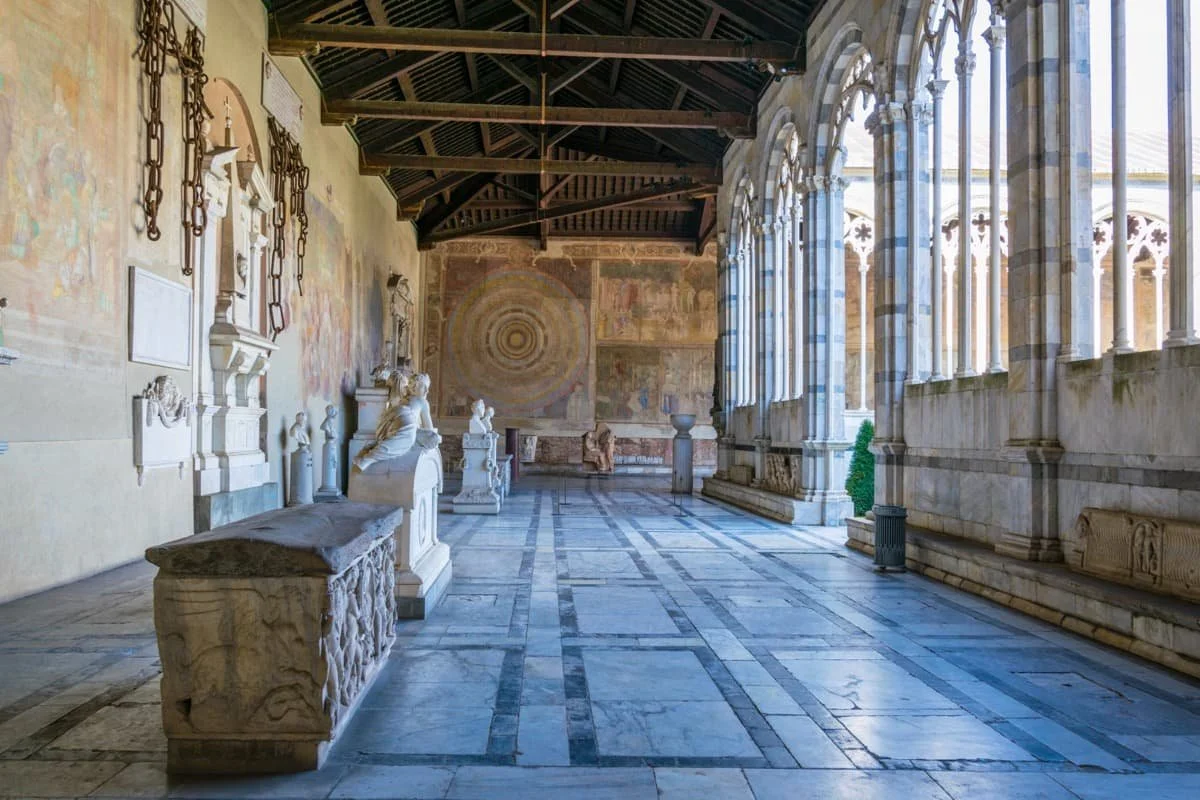
The Camposanto was never just a cemetery. It was conceived as a gathering point for the Roman sarcophagi that had accumulated around the cathedral over centuries, reused by Pisan nobles for their own burials in a very practical bit of ancient recycling. Some 84 of these survive, mostly from the 3rd century, and they line the corridors in a strangely affecting parade of carved marble.
These sarcophagi likely had a big impact on the Renaissance too. Sculptors in Pisa drew directly from them, and the influence is visible in the great pulpits of the Baptistery and Cathedral carved by Nicola and Giovanni Pisano.
Then there are the harbour chains. These gigantic chains, which once stretched across the mouth of the of the Arno, were seized by the Genoese around 1290 after defeat at the Battle of Meloria. They were broken apart as a humiliation, and not returned until Italian unification in 1860. They're a strange object to encounter in a cemetery, but a good reminder that Pisa offers way more than a wonky tower.
The Frescoes That Changed a Composer's Life
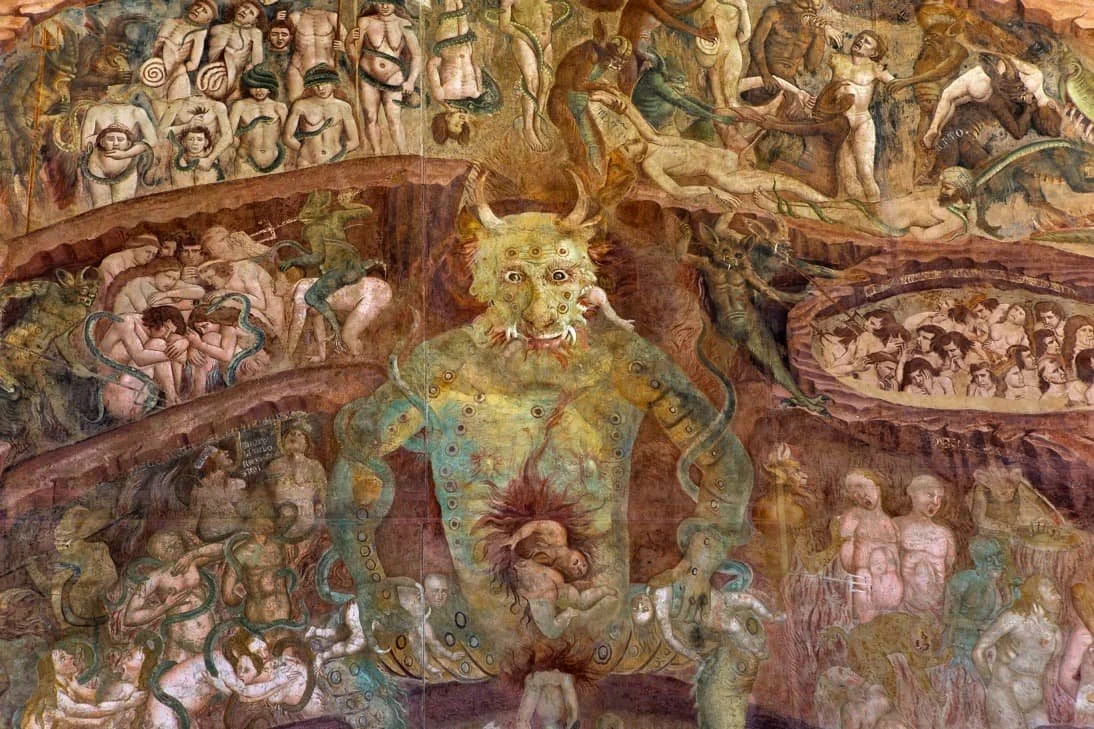
From the early 14th century onwards, the inner walls of the Camposanto were covered in frescoes, encompassing nearly 2,000 square metres of painted surface. This was easily one of the largest and most ambitious fresco programmes of the medieval period. The theme, fitting for a burial ground, was life and death.
The centrepiece was the Trionfo della Morte — the Triumph of Death — painted by Buonamico Buffalmacco between 1336 and 1341. It stretches roughly 15 metres across and 5.6 metres high, an enormous and unsettling vision of mortality. The whole thing has a cinematic sweep, medieval in its theology, strangely contemporary in its energy. That fact it was completed during a period where plague was ever present just adds to the atmosphere.
In 1838, Franz Liszt walked into the Camposanto with his mistress, the Countess Marie d'Agoult. He stood before the Triumph of Death, and the encounter lodged itself so deeply that it produced Totentanz, the "Dance of Death", a savage, virtuosic set of variations on the Dies Irae for piano and orchestra.
Fire, Lead, and the Long Restoration
On 27 July 1944, Allied aircraft bombed Pisa, still under Nazi occupation. A fragment struck the Camposanto's timber roof, starting a fire that burned for three days. The lead panels of the roof melted and ran down the frescoed walls. The damage was devastating. Sculptures were destroyed, sarcophagi cracked, and the vast majority of the fresco cycle was either lost or gravely compromised.
What followed was one of the most complex conservation efforts in post-war Italy. The surviving frescoes were painstakingly detached from the walls — and in the process, something unexpected emerged. Beneath the painted surfaces, restorers found the sinopie: the artists' original preparatory drawings, sketched in red earth directly onto the wall before the plaster was applied.
These underdrawings, never intended to be seen, revealed compositions that sometimes differed significantly from the final works. They are now housed in the Museo delle Sinopie, directly across the square.
The Triumph of Death, the best-preserved of Buffalmacco's cycle, was returned to its original position in June 2018, after a restoration spanning more than 70 years. An innovative system of sensors and back-heating now monitors the wall surface, raising the temperature by two or three degrees when conditions threaten condensation — a quiet technological intervention keeping a 14th-century painting alive.
The Surgeon, the Novelist, and the Pendulum
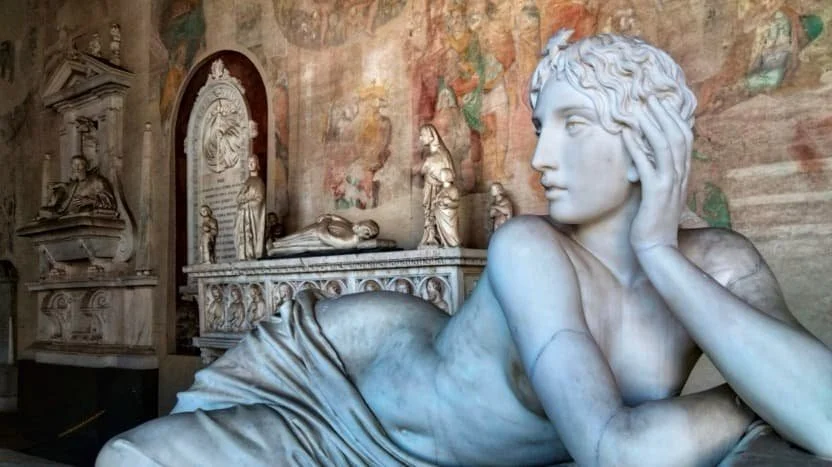
Wander deeper into the Camposanto and the surprises multiply. In the Aulla chapel hangs a bronze incense lamp, the original from the Cathedral that, according to tradition, Galileo Galilei watched swinging and used to formulate his theory of pendular motion. Near it stands a statue of Leonardo Fibonacci, the Pisan mathematician who introduced Arabic numerals to western Europe.
At the southern end, near frescoes by Taddeo Gaddi, you'll find the sepulchre of Andrea Vaccà Berlinghieri, sculpted by the Danish Neoclassical master Bertel Thorvaldsen. Vaccà Berlinghieri was a surgeon at the University of Pisa, a friend of both Percy Bysshe Shelley and Mary Shelley, and his experiments with galvanism (electrical currents applied to human tissue) have long been linked to Mary Shelley's reworking of Frankenstein, though some dispute the connection. The Shelleys were living in Pisa in the early 1820s, and the Pisa tourism authority credits their encounters with Vaccà Berlinghieri as an influence on the novel's later revisions.
Elsewhere, the Enlightenment writer and polymath Francesco Algarotti lies beneath an elaborate tomb in the western wing. His epitaph, composed by Frederick the Great of Prussia, reads: Ovidii aemulo, Newtonii discipulo — rival of Ovid, disciple of Newton. It's the kind of detail that would sound invented if it weren't carved in marble.
One of Europe's Earliest Museums
By the early 19th century, the Camposanto had evolved into something beyond a cemetery. When Napoleon's campaigns sent Italian artworks scattering, Carlo Lasinio, appointed curator by Maria Luisa, Queen of Etruria, gathered sculptures and paintings from suppressed churches and convents across Pisa and installed them within the cloister walls for safekeeping. It became, in effect, one of the first public museums in Europe.
The building still functions as both museum and memorial. Roman epigraphs line the corridors. Floor tombstones, worn smooth by centuries of footfall, carry carved effigies and inscriptions. One medieval tomb bears one of the earliest known inscriptions in the Italian vernacular — a simple address to the passer-by: "As you are, so I was; as I am, so you shall be."
Visiting
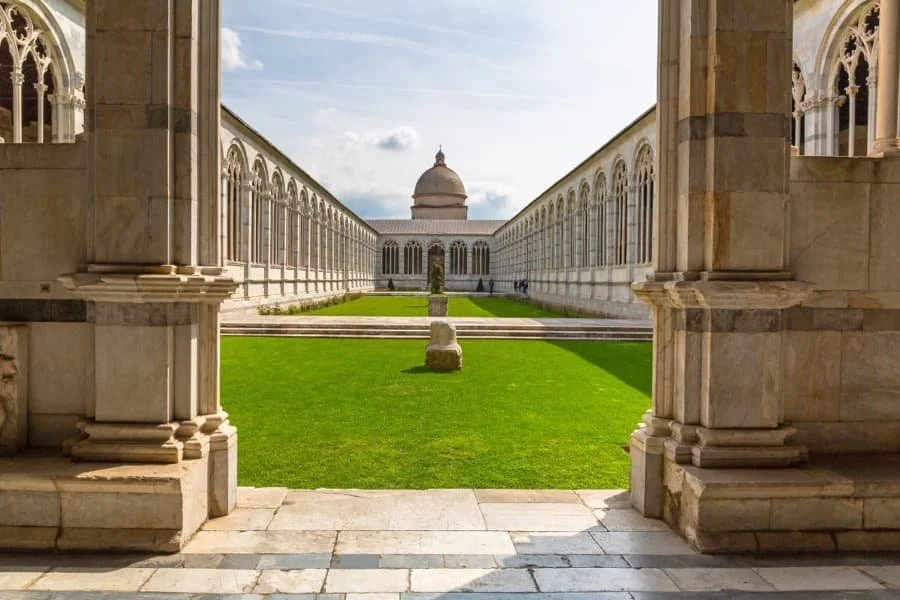
The Camposanto is managed by the Opera della Primaziale Pisana, which oversees all the monuments on the Piazza dei Miracoli. Tickets can be bought individually or as part of a combined pass covering the Baptistery, Sinopie Museum, and Cathedral; check the official pricing page for current rates, as these change periodically. Entry is free on 1 and 2 November — All Saints' and All Souls' Days — which, given the setting, feels particularly right. From mid-June through August, the Camposanto opens for summer evening visits until 10pm.
The official ticketing page allows bookings up to 90 days in advance. Unlike the Leaning Tower, which requires a timed slot and sells out days ahead, the Camposanto rarely feels crowded. An hour is enough; longer if the frescoes pull you in, which they tend to.
Pisa Centrale station is a 20-minute walk from the piazza, or a short ride on the LAM Rossa bus. Most visitors to Tuscany pass through Pisa on their way to somewhere else. The Camposanto is the best argument for not passing through too quickly.
Read Next