7 Incredible Thai Temples to Add to Your Itinerary
Make sure you visit at least one of these intricate temples on any Thailand trip
With over 40,000 Buddhist temples, Thailand has no shortage of serene local places of worship. Some are basic but still vitally important, whereas others are dazzling architectural icons that reflect the rich cultural depth that Thailand has by the bucketload.
Some are traditional, serious and often contain and important relic, usually belonging to or relating to the Buddha. Others are less formal. Some or community cornerstones, where monks and market stalls occupy the same space. You’ll never find the same temple twice in Thailand.
If you want to include some of Thailand’s best temples on your itinerary, we’ve rounded up seven starting points to help you fill your camera roll with something other than plates of pad Thai. You may even leave feeling slightly more enlightened, or at least appreciative of some amazing design and craftsmanship. Let’s jump in!
1. Wat Phra Kaew
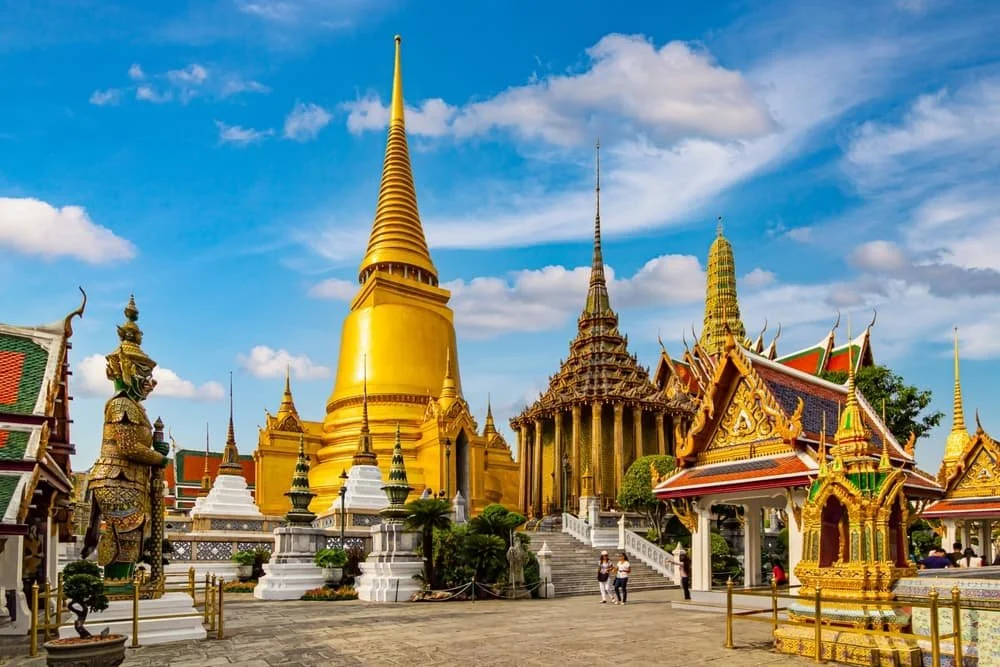
There is no temple in Thailand more loaded with meaning than Wat Phra Kaew, the Temple of the Emerald Buddha, which sits at the heart of the Grand Palace complex on the eastern bank of the Chao Phraya river.
Construction began in 1782, when King Rama I moved the Thai capital from Thonburi to Bangkok. He needed a royal temple to legitimise the new Chakri dynasty. The complex he built, with its layered golden spires, guardian giants in armour, and cloistered murals of the Ramakien epic, was designed to surpass anything that had existed in Ayutthaya or Sukhothai before it.
The centrepiece that gives the temple its moniker is a small seated figure, carved from a single piece of green jade and standing roughly 66 centimetres high. The Buddha is elevated on a towering gilded throne in the ubosot (ordination hall) so that worshippers see it from a great distance below.
Three times a year, in a ceremony presided over by the Thai king himself, the statue's seasonal robes are changed, one set for summer, one for the rainy season, one for winter. No one except the monarch is permitted near the Emerald Buddha.
Be aware that the dress code is strict. Shoulders and knees must be covered and you’ll need to remove your shoes before entering the temple (common across Thailand). Sarongs are available at the entrance if you forgot to pack long trousers or a long-sleeved shirt. It’s almost always crowded too, so get there as early as you can.
2. Wat Pho

A few minutes south of the Grand Palace, Wat Pho is older, larger, and in some ways richer than its more famous neighbour. The temple predates Bangkok itself, with a monastery recorded on the site from the sixteenth century. Rama I restored and enlarged it in 1788, and much of what stands today dates from the reign of Rama III, who undertook a sixteen-year renovation programme beginning in 1832.
The Reclining Buddha that Rama III commissioned during that project is the centrepiece. At 46 metres long and 15 metres high, plated in gold leaf, and so large it barely fits the chapel built to house it, it’s a remarkable sight even if you’ve seen your fair share of reclining Buddhas already.
The soles of the statue’s feet are inlaid with 108 mother-of-pearl panels depicting the auspicious characteristics of the Buddha. Along the opposite wall, a row of 108 bronze bowls, one for each characteristic, act as places where visitors can donate coins. The sound of them dropping, one after another, gives the hall a unique soundtrack.
Wat Pho was also designated Thailand's first public university by Rama III. Its walls and pavilions are inscribed with 1,431 stone tablets covering medicine, literature, and astronomy. The temple remains the national headquarters for the teaching of traditional Thai massage, and you can even book a massage on site.
3. Wat Arun
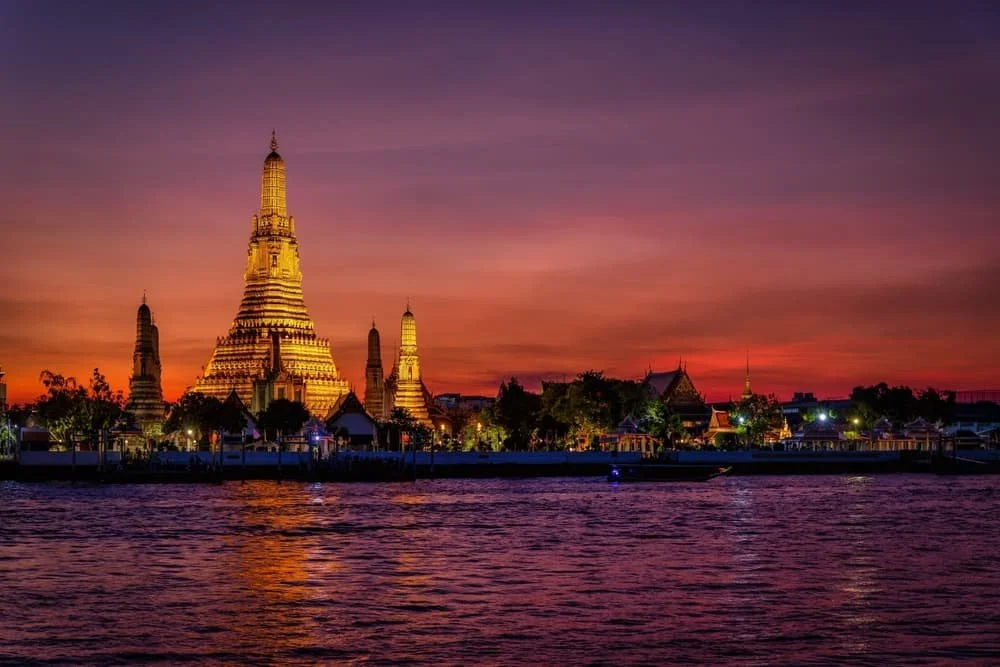
Across the Chao Phraya from Wat Pho, a short ferry crossing from Tha Tien Pier, Wat Arun is a chunk of Bangkok's skyline that predates the skyscrapers and rooftop bars. The central prang stands approximately 82 metres tall, its surface encrusted with fragments of Chinese porcelain and seashell that catch the light differently at every hour.
It’s name isn’t Buddhist, but Hindu. King Taksin, fleeing the Burmese sack of Ayutthaya in 1768, is said to have arrived at this spot by boat as the sun rose, and vowed to restore whatever temple stood here – which happened to be a Hindu temple dedicated to the god Aruna.
The Emerald Buddha was briefly housed at Wat Arun before being transferred to Wat Phra Kaew in 1785. The great prang was built later, under Rama II and Rama III, and completed in 1851. Its design, structured around Mount Meru of Hindu-Buddhist cosmology, is unique in Thailand, the tallest prang-shaped chedi in the country and the centrepiece of a UNESCO tentative list inscription.
Although you can tour the temple, this is one temple where the reward gets better the further away you are. A great option is to take a Chao Phraya sunset cruise and capture the complex during golden hour, with the seashells and porcelain changing the colour of the towers almost by the minute.
4. Wat Rong Khun
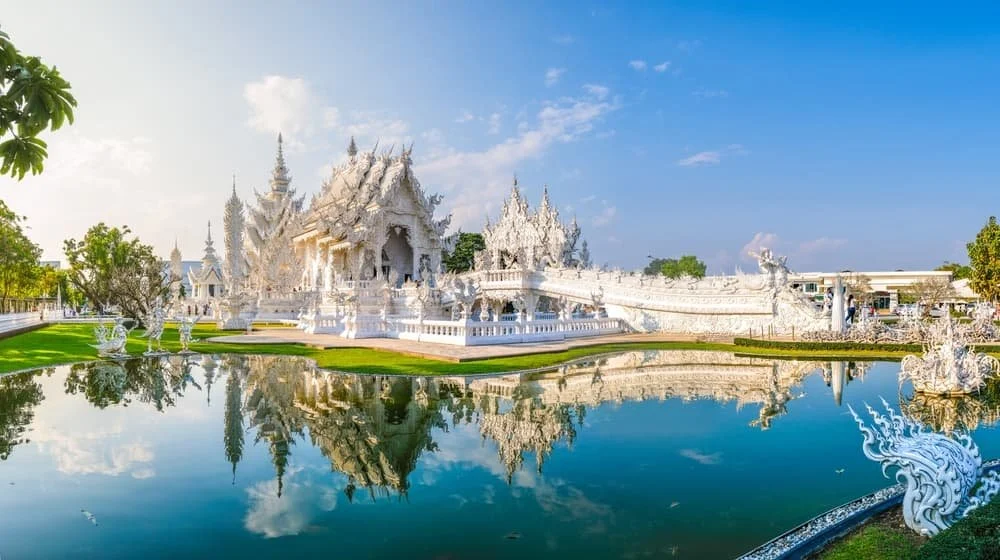
Thirteen kilometres south of Chiang Rai, just off the main highway, Wat Rong Khun, you’ll find one of Thailand’s most unique temples, and not just because of its design.
According to the designer, visual artist Chalermchai Kositpipat, the white finish signifies the purity of the Buddha. The blend of whitewash and mirror fragments on the surface creates a shimmering effect that is completely enchanting when the sunlight hits it.
Kositpipat bought the original, ruined temple at this site and began rebuilding it in 1997, financing the project entirely from his own earnings. By his own account he has spent more than 40 million baht of his own money, and the temple still isn’t complete – and won’t be until 2070.
First impressions are a little dark. A bridge over a pool leads to the entrance, its handrails gripped by dozens of outstretched arms reaching from below, representing souls in hell seeking salvation.
Inside the ubosot, photography is forbidden, but visitors on Reddit describe a swirling interior of murals in which traditional Buddhist imagery shares space with, in true Thai quirky form, Spiderman, Neo from The Matrix, and a Terminator. The juxtaposition is intentional, and read as either irreverent or deeply considered depending on your point of view. A 2014 earthquake in Mae Lao caused damage, but this has since been repaired.
5. Wat Phra That Doi Suthep
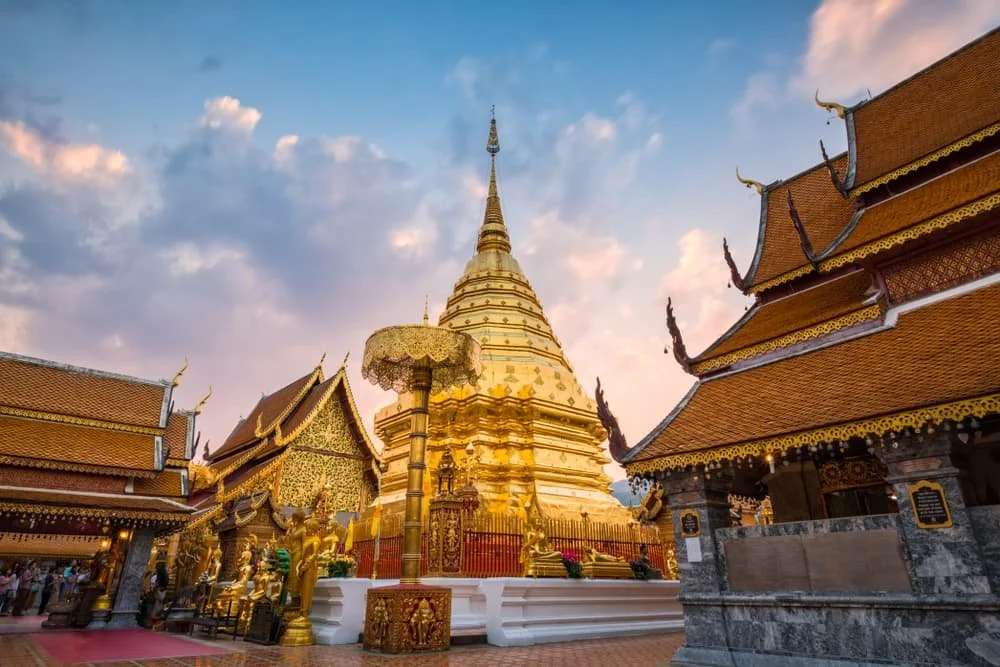
Just getting to this incredible Thailand temple is an experience in itself. The road to Wat Phra That Doi Suthep winds 15 kilometres west from Chiang Mai's old city, climbing over 1,000 metres up Doi Suthep mountain and through the truly unspoiled Doi Suthep-Pui National Park.
Wat Phra That Doi Suthep is often seen as the most important temple in northern Thailand, and one of the most important in the country, primarily because it contains a fragment of bone, believed to be that of the Buddha himself.
The founding legend, dating the temple to 1383, involves a white elephant on which the relic was placed and released into the forest. The elephant climbed to the summit of Doi Suthep, trumpeted three times, turned clockwise, and died. King Kue Na of the Lanna Kingdom read this as a sign and a temple was built on the site of the elephant’s demise.
Be prepared for a potentially hot and sweaty climb, with the 306 steps leading up to the entrance of the temple. However, the famous ornamental balustrades decorated with Naga serpents give you something to admire on the way up.
The chedi at the top, copper-plated and gilded, stands 24 metres high and is flanked by four gilded parasols. On the far side of the complex, a viewing platform cantilevers out over the valley below, with the whole sprawl of Chiang Mai laid out in miniature.
The temple is an active place of pilgrimage; on Visakha Bucha Day, locals climb the mountain on foot and sleep at the base of the chedi to mark the birth of the Buddha, so watch your timings as you may not be able to access the temple on certain days.
6. Wat Mahathat
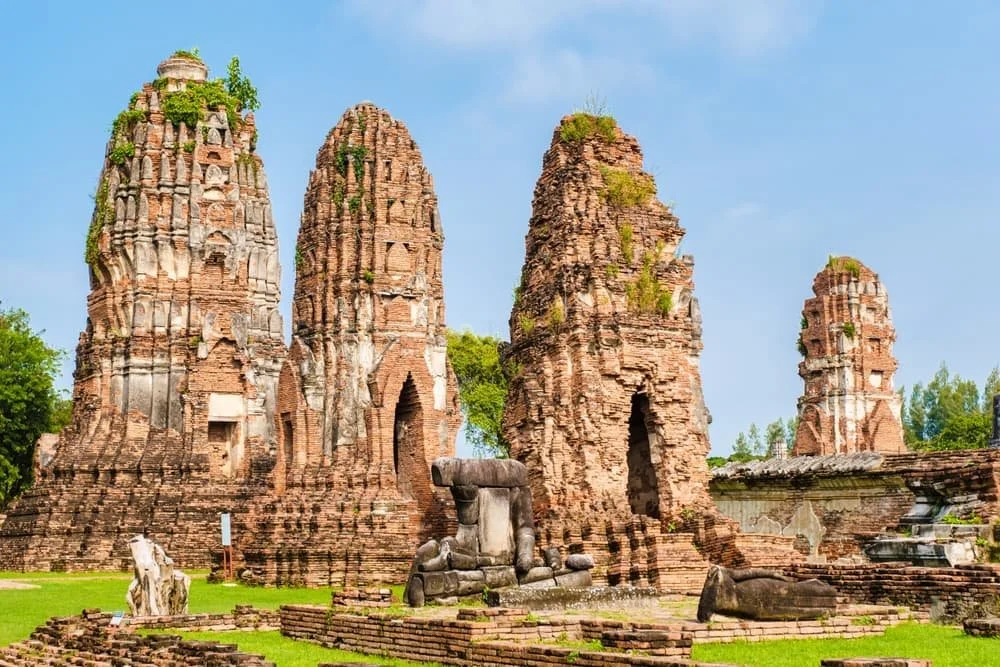
The city of Sukhothai is a three-hour drive or bus journey from Chiang Mai, or just under six hours from Bangkok by coach, and it is worth every minute of either. Inscribed as a UNESCO World Heritage Site in 1991, Sukhothai Historical Park preserves the ruins of the first independent Thai kingdom, which flourished here between the thirteenth and fifteenth centuries before being absorbed by Ayutthaya.
The park covers 70 square kilometres. The central zone, enclosed by the original city walls and their triple moat, contains the most significant temples. The best way to get around the central zone is by bicycle, rented at the gate for around 50 baht.
At the heart is Wat Mahathat, the great temple whose name translates simply as "temple of the great relic." Founded by the kingdom's first king, Sri Indraditya, its main lotus-bud chedi was built in 1345.
It was here that King Mongkut, then still a monk, discovered the Ramkhamhaeng stele in 1833, the earliest known example of written Thai, now in the National Museum in Bangkok.
The eight-metre bronze Buddha that once served as Wat Mahathat's presiding image, the Phra Sri Sakyamuni, was removed by Rama I in 1801 and installed in Wat Suthat in Bangkok, where it still stands.
But what remains at Sukhothai is perhaps more affecting. The landscape of stone and grass and still water, where seated Buddhas emerge from ruins, still shows the scale of what was lost or relocated.
7. Wat Phra Yai
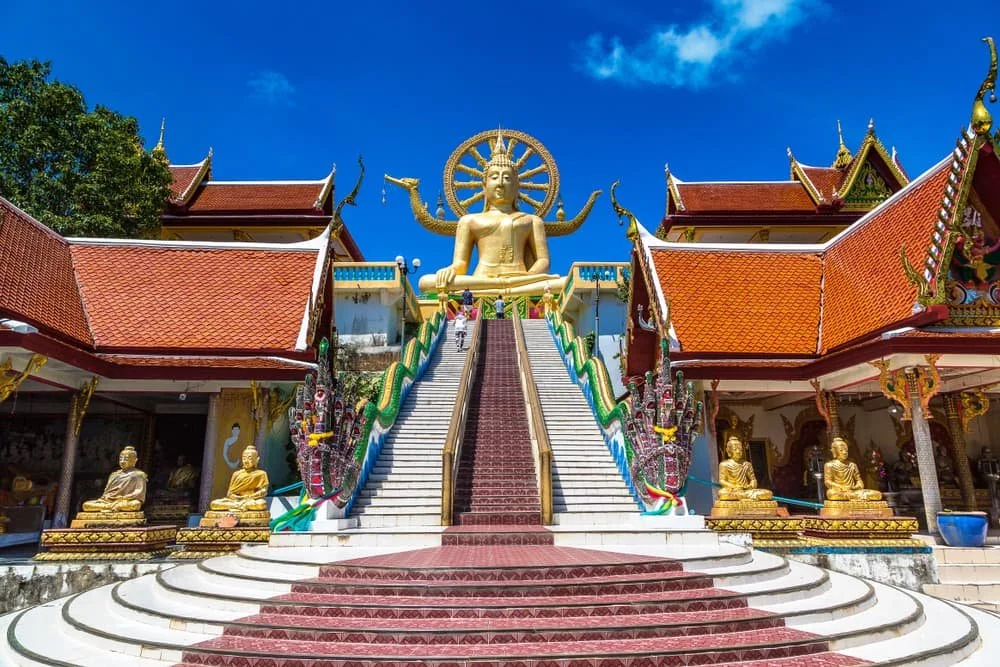
On the northeast coast of Koh Samui, connected to the main island by a short causeway, the small rocky islet of Koh Fan is home to a 12-metre gold-painted Buddha that has served as the island's most visible landmark since 1972.
One of Thailand’s younger temples, and smack-bang in one of Thailand’s most tourist-heavy destination, Wat Phra Yai has a different atmosphere than other Thai temples, with all nationalities climbing the steps or browsing the little market that pops up outside. That being said, it’s still a significant temple locally. Despite the touristy vibe, it remains an active temple, with monks in residence and daily ceremonies that run alongside the regular flow of visitors.
The wide staircase is again flanked by emerald-painted naga serpents that are slightly more colourful than other counterparts, and a ring of bronze bells can be struck with wooden mallets for good fortune.
The appeal of Wat Phra Yai is partly its contrast with everything else on this list. It doesn't have eight centuries of history behind it. It doesn't conceal a relic or a conquered empire.
It has an impressive Instagram-worthy giant gold statue, the Gulf of Thailand spread below it, and the neighbouring island of Koh Phangan visible on a clear day across the water. Sometimes that is enough.
Read Next