The best spots in Europe for Art Nouveau architecture
Where to experience some of Europe’s most audacious – and organic – buildings
For an art and architecture movement that lasted barely two decades, Art Nouveau certainly made an impression, and left a lasting mark on cities both in Europe and around the world.
Kicking off in Brussels in the 1890s and all but falling out of vogue by the end of the First World War, the movement produced some of the most audacious buildings in European history. The remains are scattered, city by city, in buildings that range from UNESCO-listed masterworks to quietly deteriorating terrace houses. But the hunt for them could form the basis for a lifetime of trips.
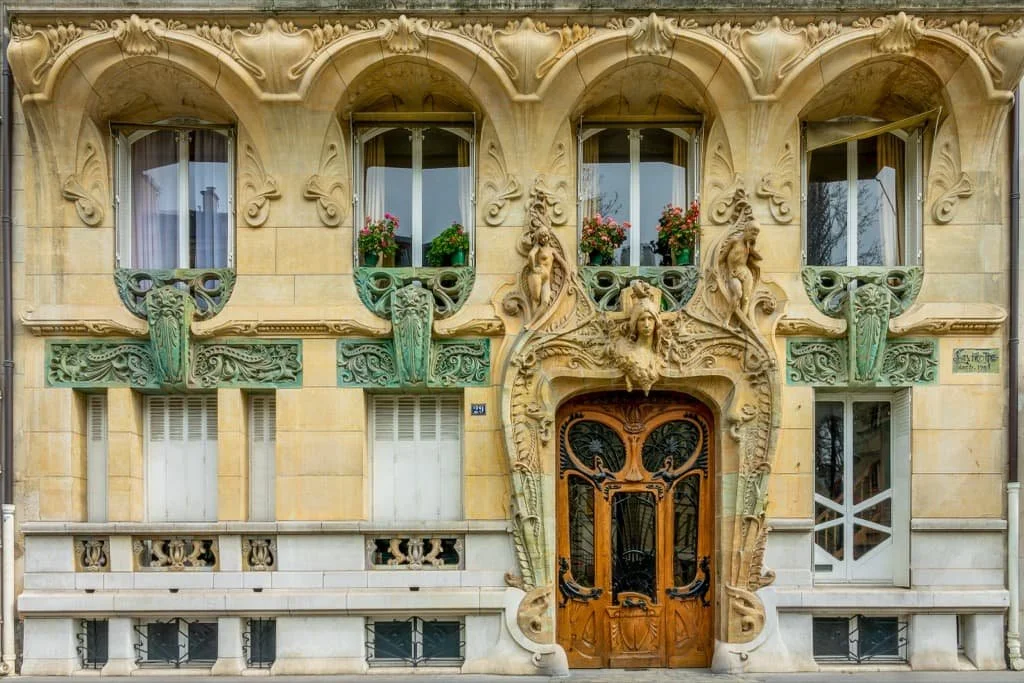
If you aren’t quite a design expert, Art Nouveau is characterised by sinuous, organic lines drawn from nature. Think flowing stems, unfurling leaves, insect wings and ‘natural’ lines applied across every element of a building from its structural ironwork to its door handles.
Alongside the look and feel, the movement was also a reaction against historical pastiche, favouring new materials like exposed iron and plate glass. Designers often insisted that architecture, furniture, and decorative arts be conceived as a unified whole, rather than architecture, interior design, furniture and decorative art being different jobs for different people.
In this article, we take a look at the Art Nouveau hotspots where the architecture really took flight, sharing the essential buildings, plus a few ideas to create a unique and certainly lesser-done architecture trip to any of these destinations.
Brussels, Belgium
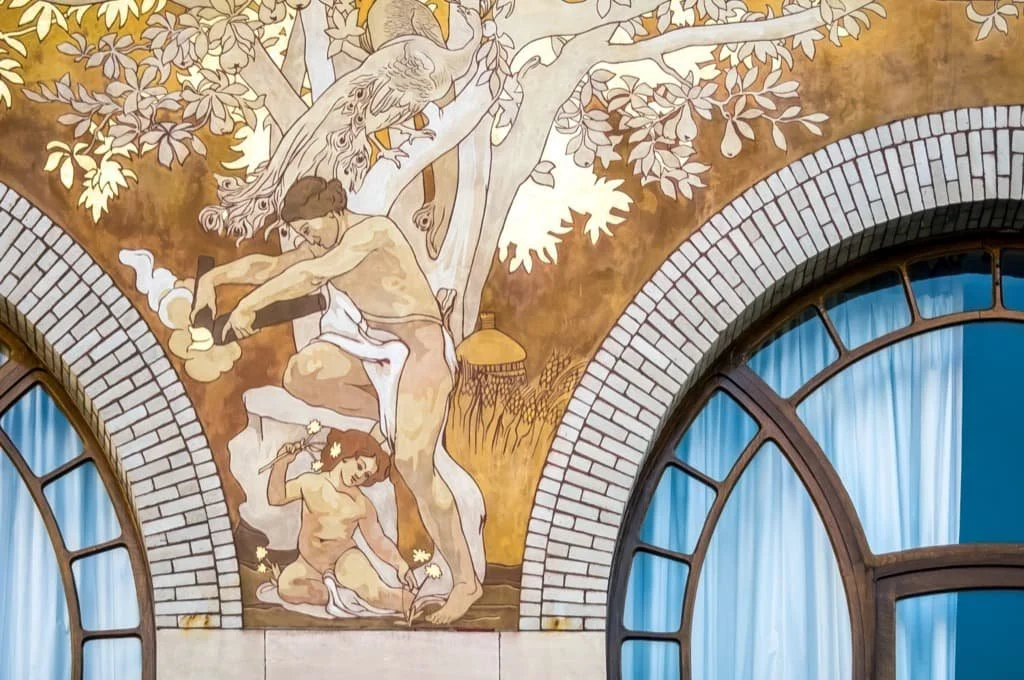
Virtually anything to do with Art Nouveau leads back to Brussels. It was here, in 1892, that Victor Horta designed the Hôtel Tassel on Rue Paul-Émile Janson, a private house for a professor of descriptive geometry that simply didn’t look like anything around it, or indeed elsewhere on earth.
Iron was left deliberately exposed. Curvilinear lines replaced straight ones. Natural light flooded interiors that had previously been cut into dark, cell-like rooms. The movement had found its first fully realised building, and Brussels fully embraced this bold new style.
Four of Horta's townhouses, the Hôtel Tassel, Hôtel Solvay, Hôtel Van Eetvelde, and his own home and workshop on Rue Américaine, are all still standing and were collectively inscribed as UNESCO World Heritage Sites in 2000.
The last of these is now the Horta Museum, and it is without a doubt the one of best places in Europe to experience what it felt like to be a resident of a comprehensive Art Nouveau building. Mosaics, stained glass, furniture and wall decorations work as a unified whole, down to the screws on the door handles.
Beyond Horta, Paul Hankar's houses on Rue Defacqz introduced sgraffito facades to Brussels, layers of tinted plaster scraped back to create two-dimensional scenes on the building's exterior. The Maison Cauchie on Rue des Francs is the finest surviving example.
The city's Art Nouveau Pass offers guided entry to nine key sites, including the Horta Museum, Cauchie House and the Hôtel Solvay.
Riga, Latvia
According to Latvian architecture professor Jānis Krastins, Riga is home to the largest concentration of Art Nouveau buildings anywhere in the world with over 800 structures.
That number is striking, but what makes Riga different from every other Art Nouveau city is that the buildings are everywhere, not corralled into a single preserved district, and that they span three distinct variants of the style. There are so many, scattered everywhere, that you could easily walk past one without noticing.
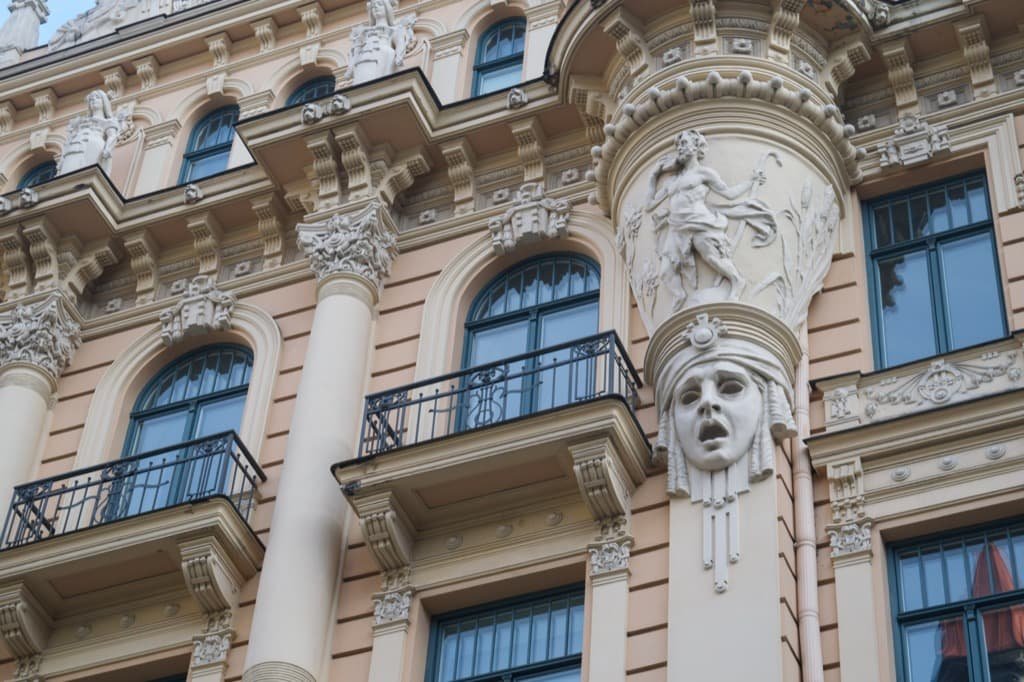
But one set of buildings you definitely won’t miss are the works of Mikhail Eisenstein, a Russian-born architect who was prolific in the city between 1901 and 1906. His buildings on Alberta Street and nearby Elizabetes Street always have a few tourists milling around below them, cameras and phones pointed skyward.
The facades are adorned with enormous sculpted female heads, open mouths, lion masks, writhing vegetation, and decorative upper floors that make these feel less like apartment blocks and more like excessive, slightly grotesque wedding cakes. The building at Elizabetes iela 10b, its facade in sky-blue tones with elongated faces emerging from the upper storey, is probably most photographed building in the city.
The Riga Art Nouveau Museum at Alberta iela 12 occupies the former home of architect Konstantīns Pēkšēns, whose practice designed some 250 buildings in the city. Its reconstructed apartment interior and original spiral staircase allow you to get behind the facade and see what the interiors would have looked like.
Nancy, France
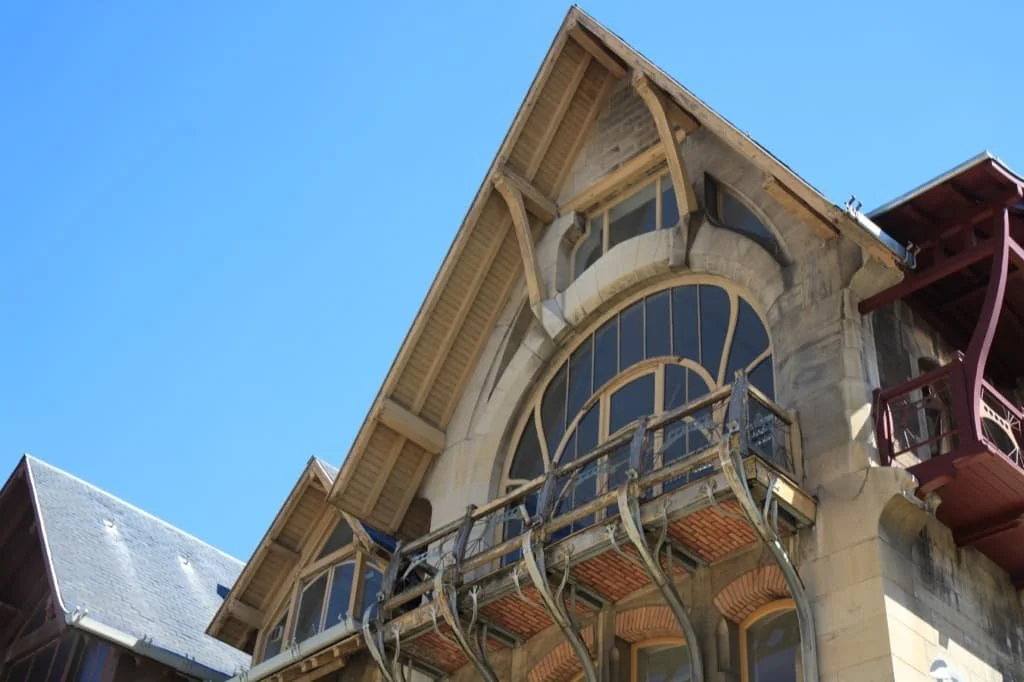
Art Nouveau in Nancy was less a style and more of an organised movement, a collective of designers and craftsmen who called themselves the École de Nancy and followed the core Art Nouveau principle that architecture, furniture, glassware, ceramics, and ironwork should be conceived together as a unified whole.
The names at the centre of it, Émile Gallé, Louis Majorelle, and the brothers Antonin and Auguste Daum, are still commercially legible today through the auction prices their work commands.
The Villa Majorelle was the first entirely Art Nouveau building in the city and is their most complete domestic statement. Louis Majorelle commissioned the young Parisian architect Henri Sauvage to design the exterior, then drew on the full resources of the school to furnish it.
The building still showcases stained glass by Jacques Gruber, ceramics by Alexandre Bigot, and ironwork and furniture by Majorelle himself. The staircase railing, wrought into plant stems and curling leaves, is the kind of object that needs a third and fourth look to really understand the shapes and craftsmanship behind it. The house is open to individual visitors on Wednesday through Sunday afternoons, with booking advised.
Another Nancy Art Nouveau essential is the Musée de l'École de Nancy is a 15-minute walk away, housed in the former residence of Eugène Corbin, the movement's most important patron. Here you can take some extra time to explore both the building and the exhibits that pad out Nancy’s history as an Art Nouveau hub.
The city's business district, the streets between Place Stanislas and the railway station, is also another easy place to go building spotting. The Brasserie Excelsior, completed in 1911, has Gruber's stained glass intact and is still serving food, which makes it one of the few Art Nouveau interiors in Europe with a functioning kitchen.
There are over 250 listed Art Nouveau buildings in Nancy in total, with the tourist office publishing a downloadable walking route.
Barcelona, Spain
Barcelona took a slight left turn with Art Nouveau. Purists will say it isn’t the same as Brussels or Nancy, but you can still draw extremely clear influences and alignment.
Catalan Modernisme took Art Nouveau's organic vocabulary and scaled it up, injected it with nationalist fervour, and produced buildings whose ambition makes their European counterparts seem, by comparison, restrained. Antoni Gaudí is the name everyone knows, but the movement's theoretical founder was his contemporary and former professor Lluís Domènech i Montaner, and it is Domènech's buildings that maybe need some closer attention.
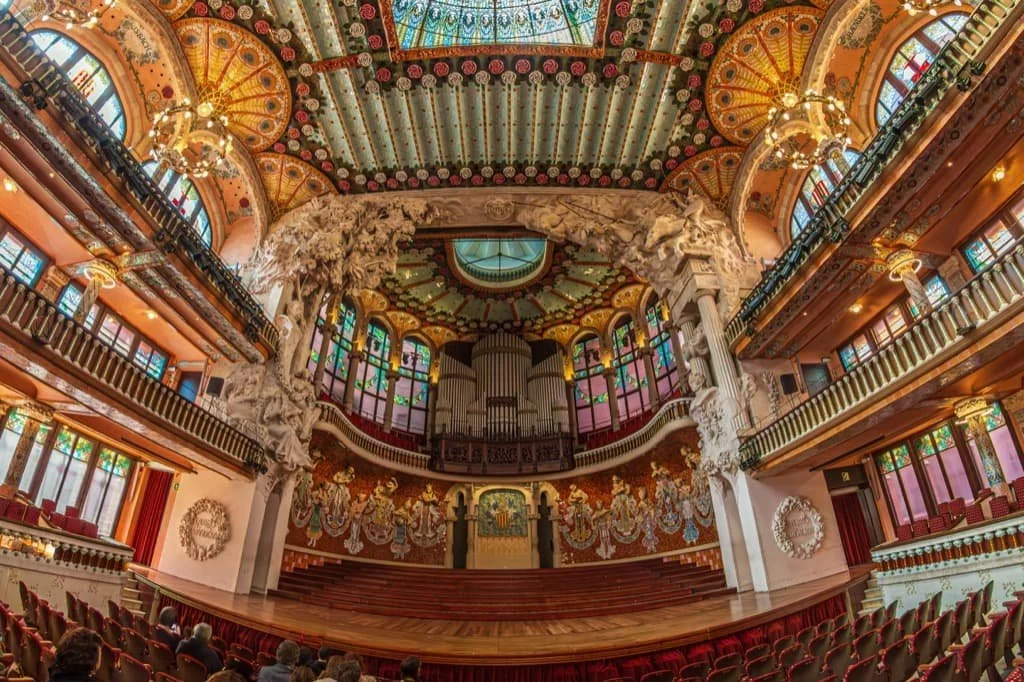
The Palau de la Música Catalana, built between 1905 and 1908 in the cramped lanes of the Casc Antic, was commissioned by the Orfeó Català choral society and financed in large part by Barcelona's industrial bourgeoisie.
It’s hard to really describe the theatre. You need to see it to understand how unique it really is. The auditorium is the only auditorium in Europe lit entirely by natural light during the day. Its walls are largely composed of stained glass set in enormous arches, making it more of a cathedral than a theatre. The whole effect is exacerbated by its ceiling, dominated by an inverted dome of amber-gold and blue glass designed by Antoni Rigalt.
Domènech described his ambition as creating "a garden for music", which is definitely mission accomplished when you consider how bright it gets in there.
The Palau became a UNESCO World Heritage Site in 1997, alongside his other major work in the city, the Hospital de Sant Pau, which is arguably the biggest chunk of Art Nouveau real estate on earth.
The complex was built as a hospital campus, and is now a museum. The scale is utterly remarkable, and like the Palau, the interiors need just as much attention as the building outside. You’ll also notice there are fewer crowds here compared to Gaudí's sites, which just goes to show what good marketing can achieve.
However, Gaudí's Casa Batlló and Casa Milà on the Passeig de Gràcia are still essential for understanding how far the Catalan variant diverged from European Art Nouveau. Both buildings resemble living organisms more than architecture, their facades in constant apparent motion.
Paris, France
Paris has the most complicated relationship with Art Nouveau of any city on this list. It produced some of the movement's most recognisable urban objects, then spent the better part of the twentieth century demolishing them.
Of the 141 Métro entrances Hector Guimard designed between 1899 and 1913, fewer than 90 survive, and many not in their original intended forms, or even correct locations. His Salle Humbert-de-Romans concert hall, built in between 1898 and 1901 and considered by many contemporaries his finest work, was torn down in just 1905. The Castel Henriette in Sèvres went in 1969. What remains is still significant, but its significance is partly inseparable from what's gone.
Guimard came to Art Nouveau via Victor Horta. In 1895 he travelled to Brussels, met Horta, and saw the recently completed Hôtel Tassel. When he returned, he redesigned an apartment building he already had started planning along entirely different lines.
The result was the Castel Béranger, completed in 1898 at 14 Rue Jean-de-la-Fontaine, a building which still stands. The original spec contained 36 apartments with an asymmetrical facade combining brick, ceramics, glazed sandstone, and cast iron, with seahorses climbing the ironwork.
The entrance gate was so unnervingly original it won the City of Paris prize for the most beautiful new facade that year. It remains a listed historic monument and is still residential, viewable from the street.
The Paris Métro commission followed almost immediately. Guimard was appointed in January 1900, with only months to spare before Line 1 needed to open for the Exposition Universelle.
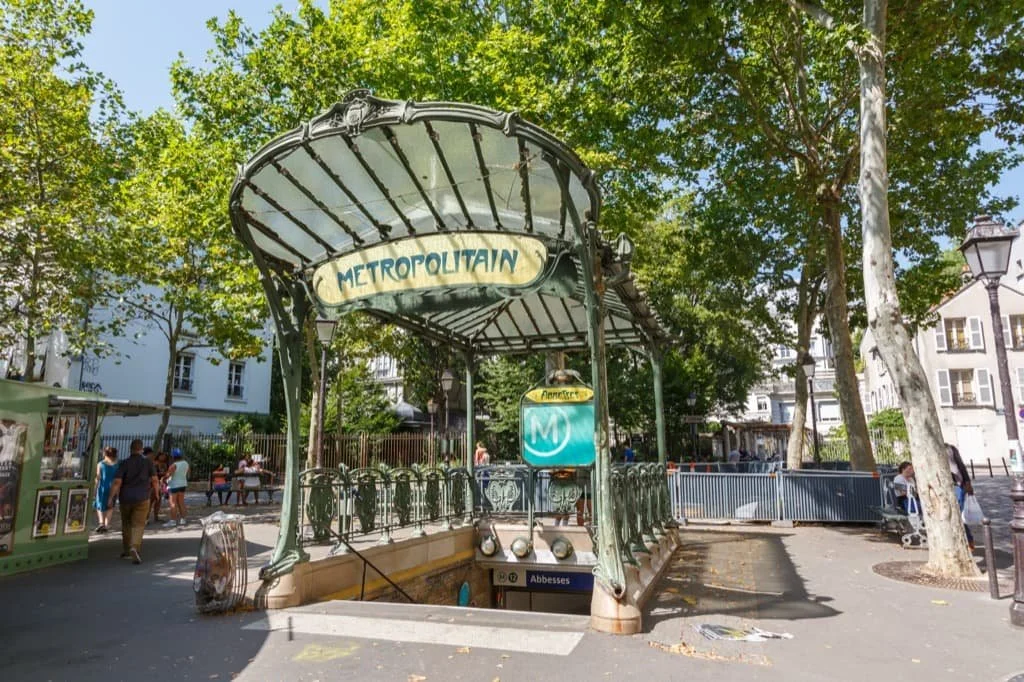
The entrances he produced, cast iron structures in sinuous green with globe lamps described in contemporary accounts as resembling eyes or flowers, popularised Art Nouveau with an audience that had never encountered it.
Rather than the trains or even the logo, the entrances and accompanying signs he produced have quickly become the images most associated with Paris’ metro system.
They were also, almost immediately, controversial. Critics attacked the green as "German" and the lettering as confusing and decidedly un-French. The city eventually discontinued its relationship with Guimard in 1904 after objections to his design for the Opéra station entrance.
Of the surviving 86 structures, now classified as historic monuments, the Porte Dauphine entrance on Line 2 is the only one remaining in its original location and édicule form, with its glass roof intact. The Abbesses station entrance, also a full édicule, was actually relocated from the Hôtel de Ville station in the 1970s.
For Guimard's buildings, the 16th arrondissement is the place to see them. The Hôtel Mezzara at 60 Rue Jean-de-la-Fontaine, a restrained private house from 1910 compared to the exuberance of the Castel Béranger, is currently being prepared as a dedicated Guimard museum, expected to open in 2027.
The Musée d'Orsay holds substantial Art Nouveau decorative arts collections too, including Majorelle furniture and examples from the Nancy School, and provides the broader European context that the buildings alone cannot.
Aveiro, Portugal

Despite not really coming close to the other places on this list, Aveiro's inclusion isn’t just an afterthought. The city of some 73,000 people on Portugal's Atlantic coast, sometimes called the Venice of Portugal, holds a genuine and unusual chapter of Art Nouveau history.
Nobody told the Portuguese that Art Nouveau had seriously taken off anywhere else; it was called the ‘Aveiro style’ in the local press until someone noticed Paris, Brussels and Barcelona had also discovered this ‘unique’ design approach too.
But Aveiro’s examples are distinct enough in character to have earned the title ‘cidade-museu da Arte Nova’ and membership of the Réseau Art Nouveau Network, alongside Brussels, Barcelona, and Riga.
The story behind Aveiro is specific too. In the early years of the twentieth century, Portuguese emigrants who had grown wealthy in Brazil began returning to Aveiro and commissioning houses that announced their success. They brought with them a taste for contemporary European style, which local architects, principally Francisco Augusto da Silva Rocha, interpreted through an emphatically Portuguese lens.
The result is a branch of Art Nouveau that deploys azulejo tiles in ways no other movement ever considered. The hand-painted ceramic tiles from the local Fábrica da Fonte Nova add a local flair to the flowery frontages. Plus, they work as waterproofing on the city's canal-facing facades.
Related Reading
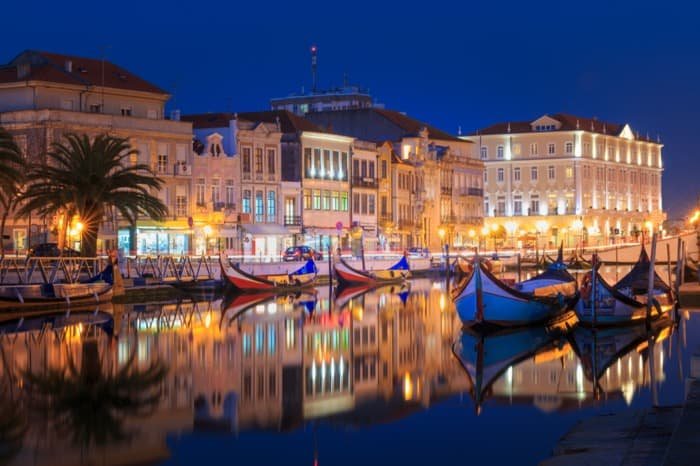
The Museu Arte Nova occupies the Casa Major Pessoa on Rua Barbosa Magalhães and serves as the starting point for a mapped walking route of 28 listed buildings. The museum itself, attributed to Silva Rocha and Ernesto Korrodi, has a stone facade dense with floral carving and wrought iron detail, topped by a stone eagle.
Inside, azulejo panels depicting birds and flowers in the Arte Nova manner line the walls. The Former Cooperativa Agrícola on the Rossio waterfront, completed in 1913, is the building most visitors photograph. Its entire facade is covered in hand-painted lily tiles by Licínio Pinto from the Fonte Nova factory, and it sits directly beside the canal where the city's flat-bottomed moliceiro boats still operate. The concentration of buildings runs highest along Rua João Mendonça and Rua Barbosa Magalhães, and is best walked.
Read Next