Is Aveiro, Portugal, Actually a Good Venice Alternative?
Aveiro is a cute, compact historic town that has elements of Venice, if you squint hard enough – but does it come close to the real thing?
Somewhere along the way, Aveiro acquired a nickname it didn't ask for and can't quite live up to. You’ll read about the “Venice of Portugal" on every tourist board website, every day-trip listing from Porto and plenty of Portugal travel blogs. It's the kind of comparison that sounds generous but does more harm than good, because anyone who arrives expecting Venice will spend the afternoon wondering what they've missed.
Sure, Aveiro has canals. It has boats that look a bit like gondolas, sort of. But, being brutally honest, it is not Venice.
It isn't built on water. It doesn't have 400 bridges or a thousand years of Byzantine and Gothic architecture reflected in a lagoon. Measuring Aveiro against Venice is like comparing a funfair to Disneyland. Sure, you’ll have fun at the fair, but it’s just not in the same league.
So forget the comparison for a second. Aveiro, taken on its own terms, is a quietly excellent Portuguese city with a distinct personality, a food scene that punches above its weight, and enough visual and historical texture to fill a proper day or a slow weekend, but don’t fall for the influencer waffle about the place being a viable Venice alternative.
A City Shaped by Salt and Seaweed
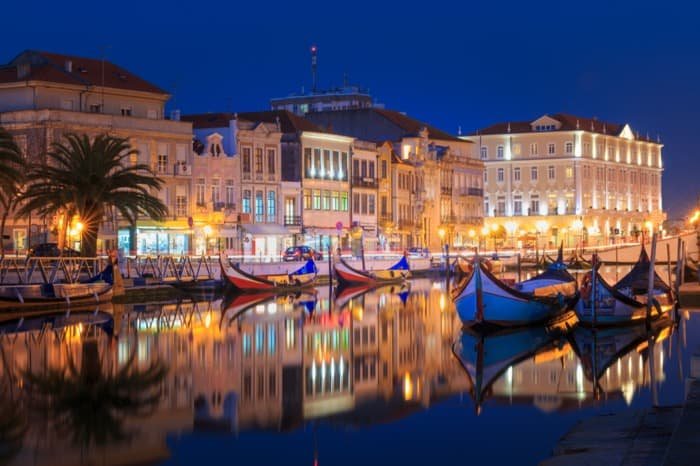
Aveiro’s canals are real enough, and they do cut through the centre, radiating outwards from the old town towards the vast tidal lagoon of the Ria de Aveiro.
But rather than being true thoroughfares to cut through marshy islands, they were built for transporting goods. Aveiro's economy ran for centuries on salt and seaweed, and the waterways served as transport routes for both.
Salt production here dates to at least 929 AD, and they were still scraping it out of the lagoon on a truly industrial scale well into the 1950s. There are still nine functioning today, and you can actually walk through these surviving salinas on a guided tour.
The boats, too, have a working history. The moliceiros, those high-prowed, brightly painted craft that drift along the Canal Central, were designed in the 19th century for harvesting moliço, the lagoon seaweed that local farmers used as fertiliser.
The moliceiros are flat-bottomed, built from pine, roughly 15 metres long, and, like Venice’s gondolas, are propelled by a pole rather than an oar. The decorative panels at bow and stern were originally painted to identify the owner, though modern moliceiros tend towards cheeky, frequently bawdy illustrations aimed squarely at the tourist trade.
Although you won’t drift below the Bridge of Sighs or cut across the Grand Canal, you’ll pay a tiny fraction for a ride and the moliceiro pilot will probably actually try and talk to you, marking one thing that Aveiro actually does better than Venice…
An Art Nouveau Hotspot
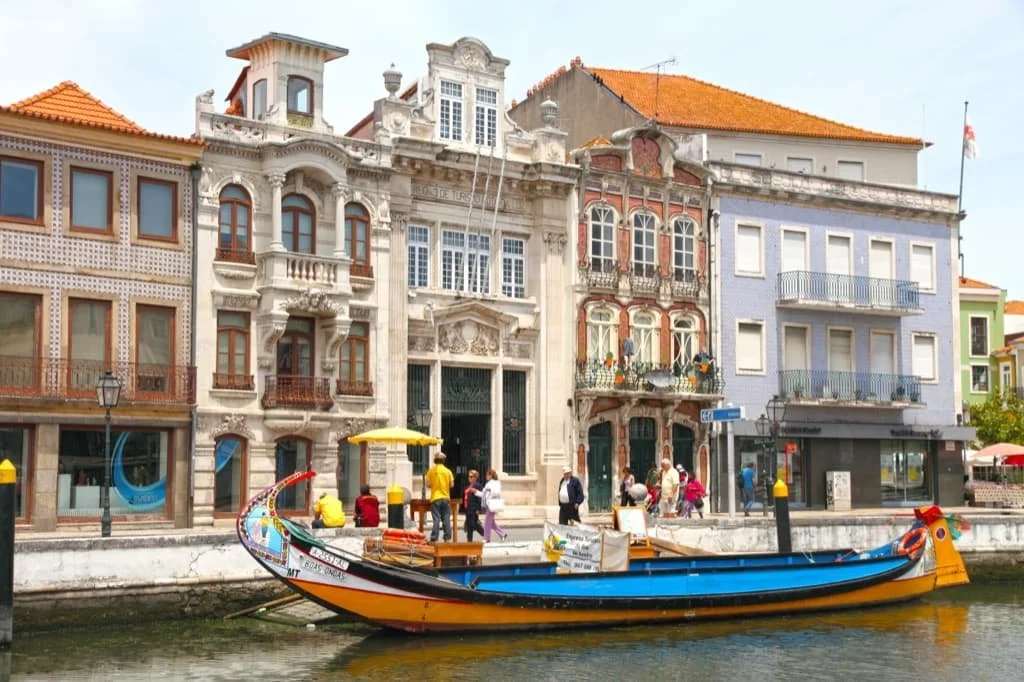
Where Venice has palazzi, bridges and frescoes, Aveiro competes with one of Europe's best-preserved collections of Art Nouveau architecture, concentrated along a few walkable streets around the Canal Central and Rua João Mendonça.
In the early 1900s, Portuguese emigrants who had made their fortunes in Brazil returned to Aveiro and spent their wealth on making their old homes look swish and sophisticated, copycatting the fashionable Art Nouveau buildings popping up across Europe.
Between roughly 1904 and 1920, a wave of ornate façades went up across the city centre, heavy with wrought iron, the typically sinuous stonework of the style, and the distinctly Portuguese addition of Art Nouveau azulejo tiles. The local press at the time called it the "Aveiro Style," apparently unaware that artists and architects in Paris, Brussels and Budapest were already ahead of the game.
Aveiro is now a member of the Réseau Art Nouveau Network, a European association of cities with significant Art Nouveau heritage. It sits in a group alongside Barcelona, Brussels, Riga, Budapest, Glasgow, and Havana, which is not bad company for a Portuguese city of 80,000 people.
The Museu Arte Nova, housed in the former Casa Major Pessoa, is your must-visit if you’re vaguely interested in architecture, but you can also appreciate the city’s Art Nouveau buildings by simply wandering through the centre.
What to See Beyond the Canals

A place that best captures Aveiro's layered history is the Museu de Aveiro, housed in the 15th-century Mosteiro de Jesus. The convent owes much of its fame to Princesa Joana, who tried to become a nun, but was denied the chance by her family. Turns out princesses were more valuable than nuns.
Her tomb, a 17th-century work of inlaid marble mosaic in multiple colours, occupies the former lower choir stalls and is the museum's centrepiece. Around it, the convent unfolds into a sequence of Baroque gilt chapels, azulejo-tiled cloisters, and rooms of religious painting spanning the 14th to 19th centuries.
A few minutes' walk away, the old railway station offers a museum-like experience without trying. Built in 1916 and designed by architect José Coelho, the building is covered on all sides with around 50 azulejo tile panels by artists Francisco Pereira and Licínio Pinto. The famous blue tiles are essentially framed portraits of early 20th-century Aveiro, with salt collection, fishing and farming featuring heavily.
The Praça do Peixe, the old fish market square, sits in the Beira Mar district on the north bank of the Canal de São Roque. The square and the streets around it form the liveliest part of the old town, with a concentration of restaurants and bars that fill up in the evenings.
This is also the neighbourhood to try ovos moles, the local convent sweet made from egg yolks and sugar inside thin wafer casings shaped like shells and fish. Confeitaria Peixinho, which has been baking since 1856, is the oldest producer.
If you need something more substantial, and you’ve remembered to book well in advance, Salpoente occupies two former salt warehouses on the Cais de São Roque and has featured in the MichelinGuide consistently since 2012. The kitchen apparently leans heavily on bacalhau and regional seafood.
Don’t Miss the Candy Stripes by the Sea
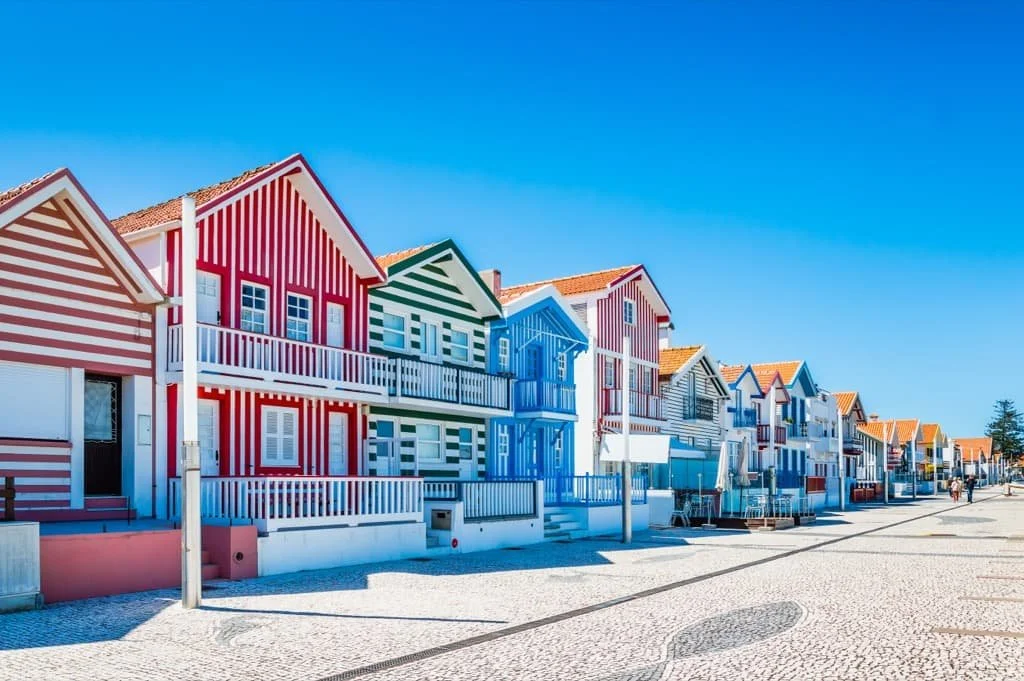
If you’re stopping off in Aveiro, then you need to make time to drop by Costa Nova too. This sleepy strip of sand wedged between the Atlantic and the Ria de Aveiro lagoon is best known for its row of vertically striped wooden houses. These are palheiros, originally 19th-century storage sheds where fishermen kept their nets and tackle.
When sea-bathing became fashionable towards the end of the century, the fishermen began renting out their huts to summer visitors, and someone had the idea to paint them in bright stripes.
The effect is unashamedly photogenic, and Costa Nova leans into this without apology. But behind the stripes there's a proper fishing village with a daily fish market, a coastline of wide, windswept Atlantic beach, and the Farol da Barra, Portugal's tallest lighthouse, which has been guiding ships into the lagoon since 1893.
If You Actually Want a Venice Alternative, Look at Chioggia
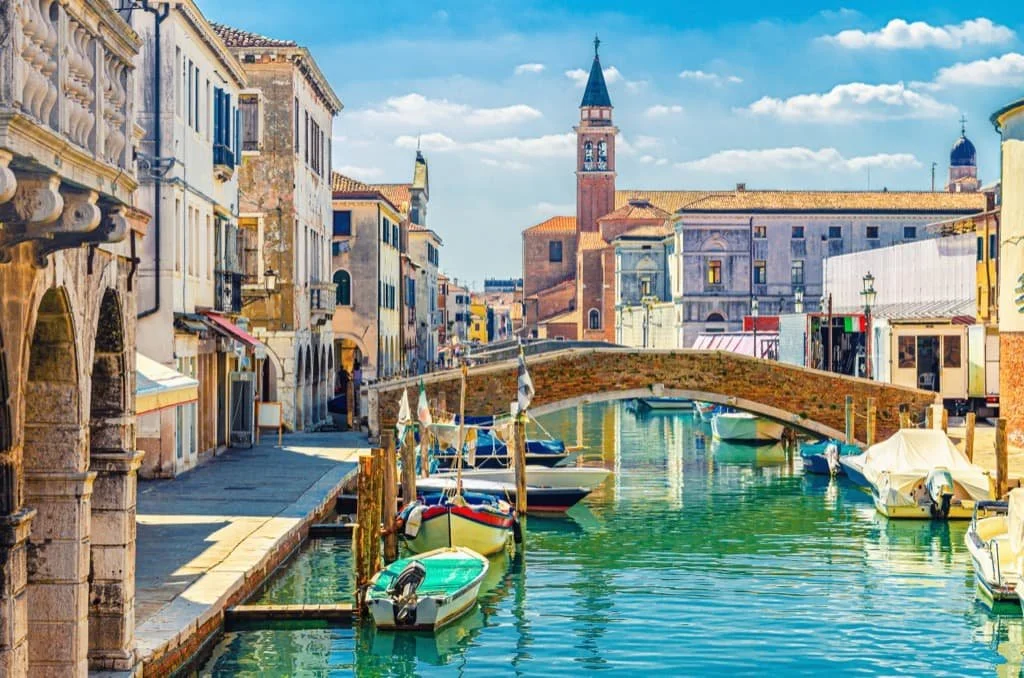
If you’ve heard that Aveiro is a good swap for Venice, but now feel slightly disheartened after reading this article, there is some good news. There is a superb Venice dupe, but it isn't in Portugal. It's 25 kilometres south of Venice itself.
The small city of Chioggia sits on a cluster of islands at the southern end of the Venetian Lagoon and shares almost all of Venice's structural DNA. You’ll recognise calli (narrow alleyways), campi (squares), canals crossed by stone bridges, and Venetian-style palazzi with their reflections trembling in the water below.
Chioggia was, in fact, part of the Republic of Venice for centuries, and the architecture, art and culture shows it. The central Canal Vena runs the length of the old town, spanned by nine bridges and overlooked by churches and coloured façades that could pass, at a glance, for a quieter Dorsoduro. The Ponte de Vigo, built in 1675, carries a stone St Mark's Lion that locals affectionately call "el gato" for its modest proportions.
The New York Times placed Chioggia at the top of its annual "52 Places to Go" list in 2022, and the town was a finalist for Italy's Capital of Culture in 2024. But despite the attention, Chioggia still doesn’t suffer the endless stream of coaches and cruise ships that have turned the dry parts of Venice into a rugby scrum in the high season.
It’s still a working fishing port where the day starts at 4am when the boats leave and peaks in the afternoon when the catch arrives at the wholesale market. Chioggia is what Venice might feel like if 30 million tourists a year hadn't found it first.
The best part is, you can go and battle the Venice crowds, then head to the (relatively) relaxed Chioggia by vaporetto, bus, and ferry, a journey of about 90 minutes that takes you along the outer rim of the lagoon through Pellestrina and past mussel farms and fishermen's huts on stilts. It’s an ideal day trip, as well as a direct replacement.
So, back to Portugal a second, and to wrap up, don’t go to Aveiro expecting Venice. But do go to explore a seriously underrated slice of Portugal that definitely isn’t overwhelmed by day trippers.
Aveiro is roughly one hour south of Porto by direct train on the Lisbon-Porto line. Regular services run throughout the day. Costa Nova is accessible by local bus from Aveiro city centre, or a short drive via the N109.
Read Next