Badlands National Park Is One of America's Great Wildlife Destinations: Here's What to Look For
Most visitors come for the geology. The real revelation is what lives here.

In Badlands National Park, The spires tend to get all the attention. Those layered, wind-carved formations that glow amber at dawn and blush pink at dusk, eroding at roughly an inch per year, dissolving in slow motion across 244,000 acres of southwestern South Dakota, are what you’ll see in the brochures and guidebooks.
Photographs of Badlands National Park tend to feature the rock and nothing else, as though the landscape were purely mineral, a beautiful dead zone. The name itself suggests as much.
But the thing that catches most visitors off guard is how thoroughly alive this place is. Beyond the buttes and the Loop Road overlooks, the park is home to the largest undisturbed mixed-grass prairie in the United States, a vast transitional grassland where over 400 plant species and nearly 60 varieties of grass support one of the densest concentrations of large mammals in the American West.
Bison, bighorn sheep, pronghorn, coyotes, swift foxes, mule deer, and black-tailed prairie dogs all share the same open terrain. Four of those species were reintroduced after being entirely wiped out. One was brought back from extinction.
So what sort of wildlife can you expect at Badlands, and what are best ways to see as much as you can, sustainably?
A Herd That Started with Two Truckloads
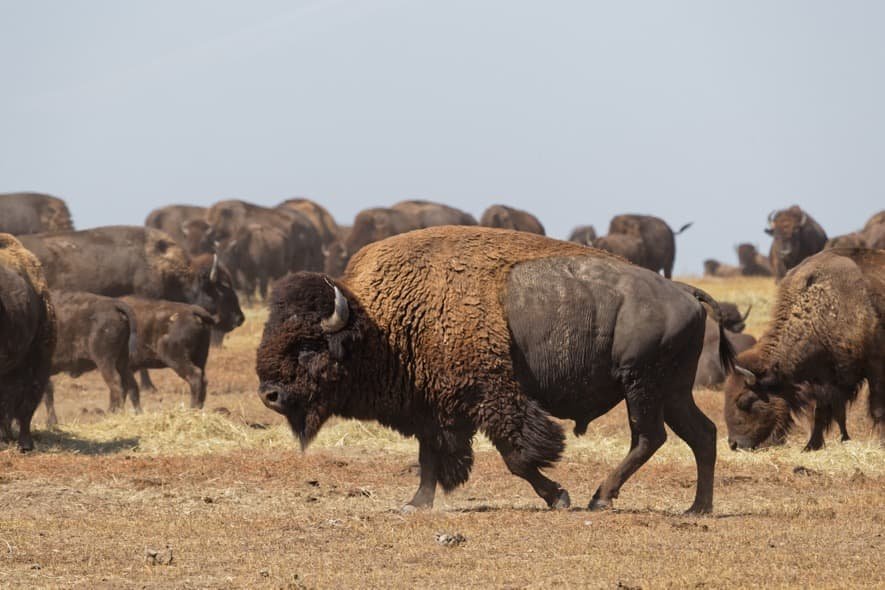
In 1963, two trucks carrying 25 bison each made the journey from Theodore Roosevelt National Park in North Dakota to the Badlands. That original stocking of 50 animals has grown into a conservation herd of over 1,200 individuals.
A 22,000-acre range expansion in 2019 opened territory that bison hadn't walked since the 1870s. It's one of the largest federally managed bison herds in North America.
The park manages it with a level of care that extends well beyond its own borders. Surplus animals from the annual autumn roundup are distributed to Native American tribes through a longstanding partnership with the InterTribal Buffalo Council, returning tatanka to tribal lands where they once roamed in the tens of millions. In 2022 alone, 655 young bison went to the Cheyenne River Sioux, Rosebud Sioux, Oneida, and Oglala Sioux tribes.
The best place to see Badlands’ bison is along Sage Creek Rim Road, the unpaved route that cuts through the Badlands Wilderness on the park's western side. The road is rough and dusty, but entirely worth the effort – and the car wash on the way home.
Bison drift across the open grassland here in loose herds, sometimes blocking the road entirely, sometimes visible only as dark shapes against the prairie a mile away. Early morning and late afternoon are the most active periods, and the low-angle light at those hours turns the formations behind them into something close to theatre, all deep shadow and warm ochre.
Remember that bison are big, heavy and angry wild animals, especially if calves are present. The general rule is that if the animals are reacting to you, you’re too close.
The Fastest Thing on the Prairie

As they stand grazing, it’s easy to overlook the Pronghorn – until one spots danger and bolts.
Capable of sustaining speeds of 55mph, with short bursts reportedly reaching 60, the pronghorn is the fastest land mammal in the Western Hemisphere and the second fastest on Earth (you already know first place).
Unlike the cheetah, though, the pronghorn can hold its pace for miles, an evolutionary adaptation developed over millennia to outrun predators. However, and sort of sadly, the American cheetah and the American lion that were the only things realistically capable of hunting and catching a pronghorn, have been extinct for 12,000 years, so the pronghorn are basically running away from ghosts.
They're commonly spotted along the Badlands Loop Road and across the Buffalo Gap National Grassland, often in small groups with a sentinel male scanning the horizon. They can detect movement from 4 miles away, which means they usually see you and move long before you see them. You’ll need binoculars and plenty of patience.
Bighorn Sheep on the Cliffs

Around 250 Rocky Mountain bighorn sheep inhabit the park, and it feels like terrain might have been designed for them. Rolling prairie for grazing, sheer cliff faces for retreat, eroded ridgelines for the kind of vertical scrambling at which bighorn sheep are almost absurdly good.
The Pinnacles Overlook area and Big Badlands Overlook are both reliable spots, as is the Castle Trail, a 5-mile route that winds through prairie grass and past stone pinnacles where sheep are frequently seen picking their way along impossibly steep ledges.
They tend to move in small groups and if you only see one, it usually means there are others nearby. Again, they are skittish and cautious, so you won’t have to worry about getting too close.
Prairie Dog Towns and the Ecosystem They Anchor

Only the most dedicated or quirky say they visit a national park for the rodents out loud. But at Badlands, the black-tailed prairie dog is arguably the most ecologically important animal in the park and deserves more attention than they get.
A keystone species, whose sprawling burrow systems, some covering thousands of acres in the Conata Basin area alone, underpin the survival of dozens of other species.
Burrowing owls shelter in abandoned tunnels. Ferruginous hawks and golden eagles hunt from overhead. Badgers and coyotes work the colonies at dawn and dusk. The prairie dog towns are homes, shelters and food markets to dozens of species.
Roberts Prairie Dog Town, located along the Badlands Loop Road near the park's Conata picnic area, offers the most accessible viewing. Spend even a few minutes here and the social dynamics become clear: sentinels standing upright on mounds, issuing sharp alarm barks, while others disappear underground at the first hint of an approach, only to reappear moments later with what looks very much like cautious curiosity.
The Return of the Black-Footed Ferret
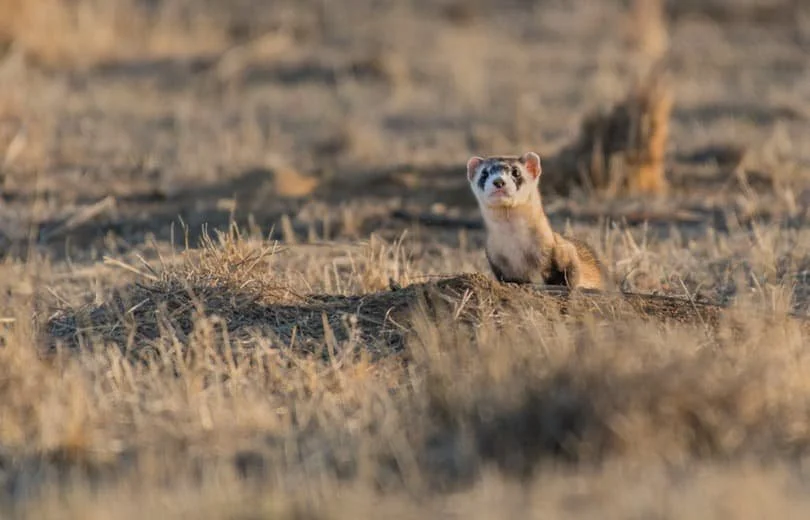
Another furry little creature, which you’ll be extremely lucky if you spot, is another Badlands critter that just doesn’t pop up as a main attraction.
By 1979, the black-footed ferret was thought to be extinct. The last captive individual died around 1980, and the scientific consensus was that North America's only native ferret had gone for good.
Then, in 1981, a ranch dog named Shep on a property near Meeteetse, Wyoming, killed a small, unfamiliar animal and brought it home to his owners, John and Lucille Hogg. They took it to a local taxidermist, who recognised it as a black-footed ferret, a species the world had given up on. Biologists descended on the ranch and found a remnant population of around 130 individuals, the last of their kind.
That colony was soon devastated by disease, and by 1987, only 18 ferrets remained on Earth, seven males and 11 females. All of them were captured and placed into a captive breeding programme that would become one of the most ambitious species recovery efforts ever attempted.
Between 1996 and 1999, and after a long search for a suitable habitat, 147 captive-bred ferrets were released into the Conata Basin area of Badlands National Park. The population took hold. By 2007, it had grown large enough for 33 ferrets to be transferred to Wind Cave National Park to establish a second colony.
The ferrets themselves are nocturnal and rarely seen by casual visitors. They sleep up to 21 hours a day in abandoned prairie dog burrows, emerging at night to hunt, so really don’t expect to see one – and count yourself very lucky if you do.
Beyond the Loop Road

Usually, a typical Badlands trip involves an hour on the Loop Road on the way to Mount Rushmore, and maybe a few overlook photographs, and a stop at the Ben Reifel Visitor Center. That covers the geology. The wildlife requires a little more time and patience.
Dawn and dusk are when the prairie wakes up. Bison move at the edges of the day. Coyotes materialise near prairie dog colonies in the early light, hunting the easiest protein on the grassland. Pronghorn drift through the open terrain at all hours. Even the bighorn sheep come down from the cliffs when the temperature dips. And the golden-hour light is worth getting up for on its own terms, but it's really the animals that make the early alarm worthwhile.
A final tip, if you don’t have lots of time, is to take the (unpaved) Sage Creek Rim Road, heading west through the Badlands Wilderness. It's where the bison range and the prairie dog towns spread out across the open grass, passable in most vehicles when dry, though it's worth checking conditions at the ranger station before you head out.
If you’re visiting the Badlands as part of an extended national park trip, then check out our guide to the much lesser-visited South Unit, almost completely devoid of tourist crowds.
Read Next